Tunguska: The Blast That Flattened Siberia
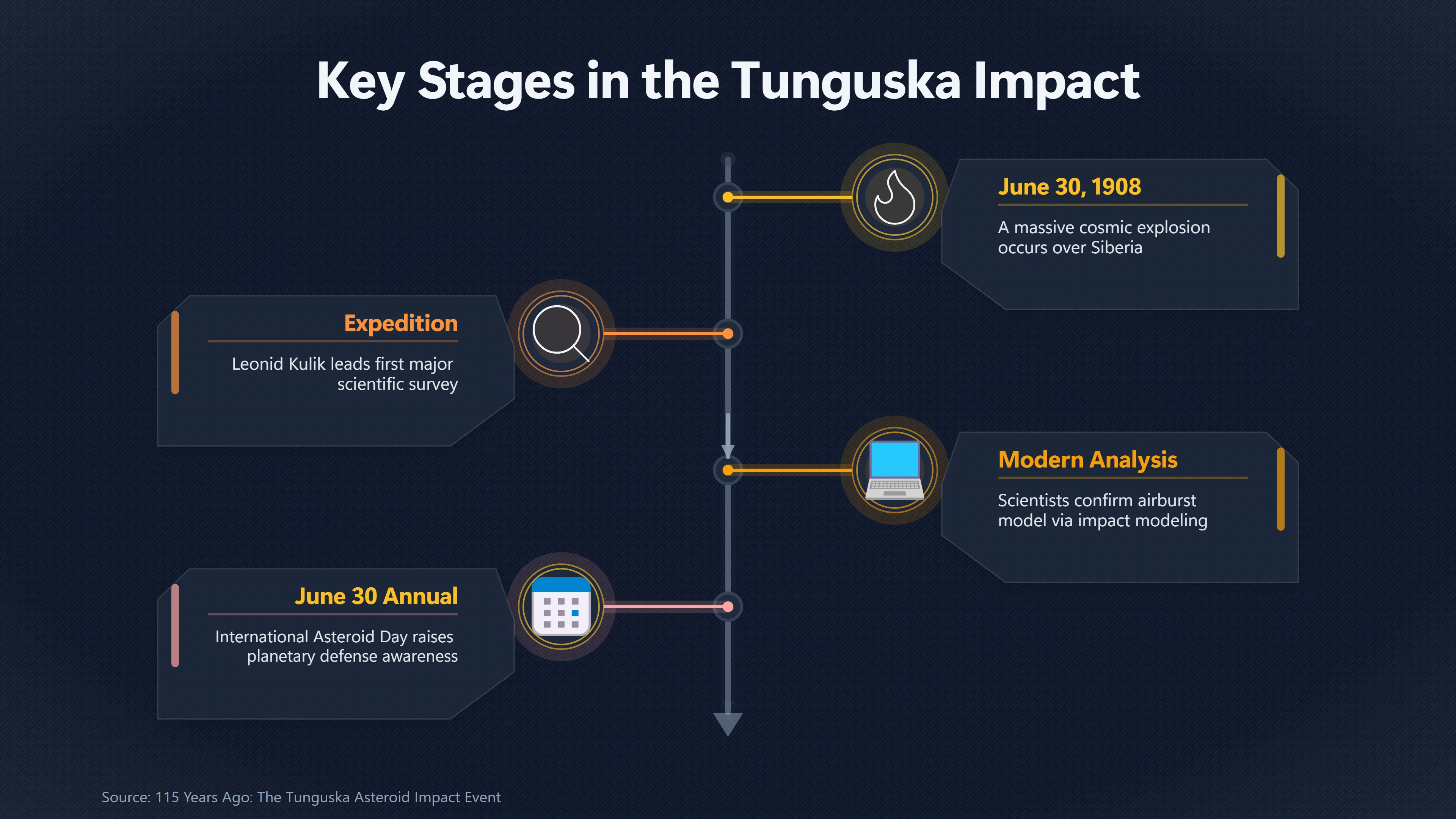
The Tunguska event of 1908 was the largest confirmed cosmic impact event in recorded history. On 30 June 1908, a powerful explosion occurred above the remote forests near the Podkamennaya Tunguska River in central Siberia, destroying a vast area of taiga without leaving a conventional impact crater.
Page outline Jump by section
Introduction
The event became famous because it combined overwhelming destruction with an apparent lack of a visible impactor. Millions of trees were flattened, shock waves travelled across continents, and eyewitnesses described a brilliant fireball and intense heat, yet no large meteorite fragment or crater was found. That gap between dramatic effects and missing physical remains created decades of debate, ranging from serious scientific disagreements over the object’s nature to unsupported claims involving exotic causes. Modern planetary science considers the airburst explanation the strongest fit for the evidence.[NASA]nasa.govTunguska Revisited: 111-Year-Old Mystery Impact Inspires New, More Optimistic Asteroid Predictions - NASAJune 26, 2019…
What happened above Siberia on 30 June 1908?
At around 7:00 in the morning local time, residents and Indigenous Evenki witnesses in the sparsely populated Siberian region reported seeing a bright object crossing the sky. Accounts collected later described a glowing trail, a flash brighter than the Sun, intense heat, and a violent blast that threw people from their feet and damaged structures. Reports also came from hundreds of kilometres away, where people observed unusual skies and felt shock waves.[NASA]nasa.gov115 Years Ago: The Tunguska Asteroid Impact Event115 Years Ago: The Tunguska Asteroid Impact Event - NASAJune 30, 2023…
The explosion occurred over a remote part of the Russian Empire, which greatly reduced the human consequences. Although there were injuries and later studies have examined possible deaths among people in the wider area, there was no mass casualty event because the blast happened over largely uninhabited forest rather than a city.[ScienceDirect]sciencedirect.comScienceDirect Tunguska eyewitness accounts, injuries, and casualtiesTunguska eyewitness accounts, injuries, and casualties - ScienceDirectJuly 15, 2019…
The physical effects were enormous. Later surveys mapped a flattened forest area covering roughly 2,000 square kilometres, with trees knocked down in a distinctive pattern spreading outward from the explosion point. Near the centre, some trees remained standing but were stripped and damaged, a pattern consistent with an explosion high above the ground rather than a direct strike.[NASA]nasa.gov115 Years Ago: The Tunguska Asteroid Impact Event115 Years Ago: The Tunguska Asteroid Impact Event - NASAJune 30, 2023…
Why scientists think it was an airburst, not a ground impact
The missing crater is one of the most misunderstood aspects of Tunguska. A large object striking the ground normally leaves a crater and surviving fragments, but Tunguska’s evidence points to the object breaking apart in the atmosphere.
An airburst occurs when a space rock enters the atmosphere at extremely high speed and experiences enormous pressure and heating. If the object is weak or fragments under stress, much of its energy can be released before reaching the surface. The resulting blast wave can flatten forests over a huge area even though the object itself leaves little or no visible trace.[NASA Science]science.nasa.govScience Meteors and Meteorites: FactsNASA ScienceMeteors and Meteorites: Facts - NASA ScienceFebruary 14, 2025…
Scientists estimate that the Tunguska object was probably around 50–60 metres across, although estimates vary depending on assumptions about its composition, speed, and angle of entry. The explosion energy is generally estimated in the range of several megatons of TNT, making it hundreds of times more powerful than the atomic bomb used at Hiroshima.[NASA Science]science.nasa.govScience Meteors and Meteorites: FactsNASA ScienceMeteors and Meteorites: Facts - NASA ScienceFebruary 14, 2025…
The event is often compared with the 2013 Chelyabinsk meteor, another atmospheric explosion over Russia. Chelyabinsk involved a much smaller object, but it demonstrated the same basic mechanism: a space rock entering the atmosphere, fragmenting, and producing a powerful shock wave without a traditional crater.[NASA Science]science.nasa.govScience Meteors and Meteorites: FactsNASA ScienceMeteors and Meteorites: Facts - NASA ScienceFebruary 14, 2025…
How the investigation unfolded after the explosion
The remoteness of the Tunguska region delayed scientific investigation. The first major expedition was led by Russian mineralogist Leonid Kulik in 1927, almost two decades after the event. Kulik expected to find a large meteorite crater, but instead found the enormous area of flattened forest and evidence of an aerial explosion.[NASA]nasa.gov115 Years Ago: The Tunguska Asteroid Impact Event115 Years Ago: The Tunguska Asteroid Impact Event - NASAJune 30, 2023…
Kulik’s work transformed Tunguska from a mysterious local disaster into a major scientific case study. Later expeditions mapped the tree-fall pattern, studied soil and vegetation, and searched for fragments of the incoming body. Researchers found microscopic material consistent with an extraterrestrial source, but no large surviving piece of the object was recovered.[NASA]nasa.gov115 Years Ago: The Tunguska Asteroid Impact Event115 Years Ago: The Tunguska Asteroid Impact Event - NASAJune 30, 2023…
The lack of a recovered meteorite remains one reason the event continues to attract debate. However, modern impact modelling, comparisons with other airbursts, and analysis of the destruction pattern strongly support an atmospheric explosion caused by a cosmic object.[American Physical Society]aps.orgJune 30, 1908: The Tunguska Event | American Physical Society…
Asteroid or comet: what caused Tunguska?
The main scientific debate has been about the type of object involved rather than whether something from space caused the explosion.
The asteroid explanation
The current mainstream view favours a stony asteroid or asteroid-like body. Orbital modelling, chemical evidence from collected samples, and comparisons with other meteor events have supported this interpretation. A rocky object would explain why it could produce a major blast while leaving little surviving material after fragmentation.[American Physical Society]aps.orgJune 30, 1908: The Tunguska Event | American Physical Society…
The asteroid explanation also fits later discoveries about near-Earth objects: relatively small asteroids can still carry enormous energy because they travel at many kilometres per second. Tunguska demonstrated that objects far smaller than the asteroid that caused the dinosaur extinction can still create regional devastation.[NASA]nasa.gov115 Years Ago: The Tunguska Asteroid Impact Event115 Years Ago: The Tunguska Asteroid Impact Event - NASAJune 30, 2023…
The comet explanation
Some researchers have proposed that Tunguska was caused by a comet fragment. Comets contain large amounts of volatile material that can break apart and vaporise during atmospheric entry, which could help explain the absence of a crater and the unusual atmospheric effects reported after the event.[Royal Museums Greenwich]rmg.co.ukOpen source on rmg.co.uk.
The comet idea was historically influential, but it is less favoured today than the asteroid explanation. The available evidence does not provide a complete chemical fingerprint of the original body, so the exact composition remains uncertain even though the general airburst model is widely accepted.[NASA]nasa.govTunguska Revisited: 111-Year-Old Mystery Impact Inspires New, More Optimistic Asteroid Predictions - NASAJune 26, 2019…
Theories that do not fit the evidence
Because Tunguska lacked a crater and a recovered object, many alternative explanations have been suggested. These have included volcanic activity, a miniature black hole, antimatter, human-made weapons, and fictional spacecraft scenarios.
Scientific investigations have not found evidence supporting these ideas. The observed fireball, atmospheric shock wave, tree-fall pattern, and extraterrestrial traces are all consistent with a natural cosmic airburst. The absence of a crater is not evidence against an asteroid or comet; in this case, it is one of the strongest clues that the object exploded above the ground.[NASA]nasa.govTunguska Revisited: 111-Year-Old Mystery Impact Inspires New, More Optimistic Asteroid Predictions - NASAJune 26, 2019…
What Tunguska taught scientists about asteroid risks
The importance of Tunguska extends beyond the historical mystery. It became a key example of the risks posed by near-Earth objects: bodies that may be too small to destroy a planet but still large enough to devastate a region.
The event also influenced modern planetary defence efforts. Space agencies now track potentially hazardous asteroids and study ways to detect or respond to future threats. The United Nations’ International Asteroid Day is held on 30 June each year, the anniversary of Tunguska, to raise awareness of asteroid impacts and planetary defence.[NASA]nasa.gov115 Years Ago: The Tunguska Asteroid Impact Event115 Years Ago: The Tunguska Asteroid Impact Event - NASAJune 30, 2023…
Tunguska remains scientifically important because it represents a rare middle ground between ordinary meteor activity and global-scale impacts. It showed that Earth can experience powerful cosmic explosions without a visible crater, and it provided a real-world example of why detecting smaller near-Earth objects matters.[NASA Science]science.nasa.govScience Meteors and Meteorites: FactsNASA ScienceMeteors and Meteorites: Facts - NASA ScienceFebruary 14, 2025…
Amazon book picks
Further Reading
Books and field guides related to Tunguska The Blast That Flattened Siberia. Use these as the next step if you want deeper reading beyond the article.
Astrophysics for People in a Hurry
Rating: 4.5/5 from 7 Google Books ratings
Over a year on the New York Times bestseller list and more than a million copies sold. The essential universe, from our most celebrated a...
Death from the Skies!: These Are the Ways the World Will End
First published 2008. Subjects: End of the world (Astronomy), Nonfiction, Physics, Science, Astronomy.
The End of the World: The Science and Ethics of Human Extinction
For thousands of years, the human race has been fascinated and haunted by the idea of the Apocalypse. But it is only now, as we approach...
A Brief History of Time
Rating: 4.0/5 from 7 Google Books ratings
#1 NEW YORK TIMES BESTSELLER A landmark volume in science writing by one of the great minds of our time, Stephen Hawking’s book explores...
eBay marketplace picks
Marketplace Samples
Live-tested eBay searches with available results related to this page.
Selected frommeteorite collectible oneBay.co.uk.



Endnotes
1.
Source: nasa.gov
Title: 115 Years Ago: The Tunguska Asteroid Impact Event
Link:https://www.nasa.gov/history/115-years-ago-the-tunguska-asteroid-impact-event/
Source snippet
115 Years Ago: The Tunguska Asteroid Impact Event - NASAJune 30, 2023...
Published: June 30, 2023
2.
Source: science.nasa.gov
Title: Science A Cosmic Explosion Over Siberia
Link:https://science.nasa.gov/earth/earth-observatory/a-cosmic-explosion-over-siberia-154488/
Source snippet
NASA ScienceA Cosmic Explosion Over Siberia - NASA Science...
3.
Source: nasa.gov
Link:https://www.nasa.gov/solar-system/tunguska-revisited-111-year-old-mystery-impact-inspires-new-more-optimistic-asteroid-predictions/
Source snippet
Tunguska Revisited: 111-Year-Old Mystery Impact Inspires New, More Optimistic Asteroid Predictions - NASAJune 26, 2019...
Published: June 26, 2019
4.
Source: sciencedirect.com
Title: ScienceDirect Tunguska eyewitness accounts, injuries, and casualties
Link:https://www.sciencedirect.com/science/article/abs/pii/S0019103518305104
Source snippet
Tunguska eyewitness accounts, injuries, and casualties - ScienceDirectJuly 15, 2019...
Published: July 15, 2019
5.
Source: science.nasa.gov
Title: Science Meteors and Meteorites: Facts
Link:https://science.nasa.gov/solar-system/meteors-meteorites/facts/
Source snippet
NASA ScienceMeteors and Meteorites: Facts - NASA ScienceFebruary 14, 2025...
Published: February 14, 2025
6.
Source: science.nasa.gov
Link:https://science.nasa.gov/solar-system/asteroids/facts/
7.
Source: nature.com
Link:https://www.nature.com/articles/s41598-025-98362-9
8.
Source: sciencedirect.com
Title: Computation of a possible Tunguska’s strewn field
Link:https://www.sciencedirect.com/science/article/abs/pii/S0019103523004244
9.
Source: sciencedirect.com
Title: The Tunguska event
Link:https://www.sciencedirect.com/science/article/pii/S0019103520302189
10.
Source: ntrs.nasa.gov
Link:https://ntrs.nasa.gov/archive/nasa/casi.ntrs.nasa.gov/20190002844.pdf
11.
Source: nas.nasa.gov
Title: feature asteroid impact atap
Link:https://www.nas.nasa.gov/pubs/stories/2018/feature_asteroid_impact_atap.html
12.
Source: sciencedirect.com
Link:https://www.sciencedirect.com/science/article/pii/S0012821X14006827
13.
Source: ntrs.nasa.gov
Link:https://ntrs.nasa.gov/citations/20000101015
14.
Source: nature.com
Link:https://www.nature.com/articles/361040a0
15.
Source: ntrs.nasa.gov
Link:https://ntrs.nasa.gov/citations/19830065169
16.
Source: sciencedirect.com
Link:https://www.sciencedirect.com/science/article/abs/pii/0019103582900963
17.
Source: sciencedirect.com
Title: Evidence for asteroidal origin of the Tunguska object
Link:https://www.sciencedirect.com/science/article/pii/S0032063396001547
18.
Source: sciencedirect.com
Title: The nuclear and aerial dynamics of the Tunguska Event
Link:https://www.sciencedirect.com/science/article/pii/0032063389900305
19.
Source: nature.com
Title: The Great Siberian Meteorite | Nature
Link:https://www.nature.com/articles/131614b0
20.
Source: aps.org
Title: American Physical Society
Link:https://www.aps.org/apsnews/2018/06/tunguska-event
Source snippet
June 30, 1908: The Tunguska Event | American Physical Society...
Published: June 30, 1908
21.
Source: Wikipedia
Title: Tunguska event
Link:https://en.wikipedia.org/wiki/Tunguska_event
22.
Source: rmg.co.uk
Link:https://www.rmg.co.uk/stories/space-astronomy/tunguska-event
23.
Source: crystalinks.com
Title: Tunguska Event
Link:https://www.crystalinks.com/tunguskaevent.html
24.
Source: geocosmicrex.com
Title: tunguska event of 1908
Link:https://geocosmicrex.com/suspects/tunguska-event-of-1908/
25.
Source: paranormal-strange.fandom.com
Title: Tunguska Event
Link:https://paranormal-strange.fandom.com/wiki/Tunguska_Event
Additional References
26.
Source: scienceopen.com
Link:https://www.scienceopen.com/hosted-document?doi=10.14293%2FACI.2025.0006
Source snippet
Misunderstandings about the Tunguska airburst event, clarifying the physical record based on new evidence – ScienceOpenJuly 31, 2025 — Is...
Published: July 31, 2025
27.
Source: pagesofhistory.org
Title: the real story behind the tunguska event of 1908
Link:https://pagesofhistory.org/the-real-story-behind-the-tunguska-event-of-1908/
Source snippet
Pages Of HistoryJuly 24, 2026 — THE REAL STORY BEHIND THE TUNGUSKA EVENT OF 1908 📅 Last updated: 24.07.2026 The Tunguska Event 1908 remai...
Published: July 24, 2026
28.
Source: youtube.com
Title: Did an Asteroid Hit Siberia? The Truth About Tunguska
Link:https://www.youtube.com/watch?v=0hp875r2MbQ
Source snippet
This video selection is directly relevant to the 1908 Tunguska event, featuring academic lectures, field visits, and scientific analysis...
29.
Source: youtube.com
Link:https://www.youtube.com/watch?v=X9iH913vb3A
Source snippet
A visit to the site of the Tunguska explosion...
30.
Source: researchgate.net
Link:https://www.researchgate.net/publication/45860813_Cometary_airbursts_and_atmospheric_chemistry_Tunguska_and_a_candidate_Younger_Dryas_event
31.
Source: researchgate.net
Link:https://www.researchgate.net/publication/388921174_New_Evidence_of_High-Temperature_High-Pressure_Processes_at_the_Site_of_the_1908_Tunguska_Event_Implications_for_Impact_and_Airburst_Phenomena
32.
Source: youtube.com
Title: A visit to the site of the Tunguska explosion
Link:https://www.youtube.com/watch?v=mQSwVMBIeKg
Source snippet
The Destruction Of The Tunguska Event! / Documentary...
33.
Source: researchgate.net
Link:https://www.researchgate.net/publication/351688177_The_cometary-asteroidal_hypothesis_for_the_1908_Tunguska_event_is_untenable
34.
Source: rgo.ru
Title: opublikovali onlayn sbornik s pokazaniyami ochevidcev tungusskogo fenomena
Link:https://www.rgo.ru/ru/article/opublikovali-onlayn-sbornik-s-pokazaniyami-ochevidcev-tungusskogo-fenomena
35.
Source: youtube.com
Title: The Tunguska Mystery Explosion
Link:https://www.youtube.com/watch?v=IImrX2G-SlY
Source snippet
Did an Asteroid Hit Siberia? The Truth About Tunguska...