Within Gemini 7 Files
Could Space Debris Explain Gemini 7?
Rocket hardware, separation debris, and the conditions of low Earth orbit provide the main conventional explanations for the unusual sighting.
On this page
- Launch hardware and separation events
- Reflective objects in low Earth orbit
- Why space observations can be misleading
Page outline Jump by section
Introduction
The most plausible conventional explanation for the Gemini 7 sighting is that the astronauts were observing objects connected with the spacecraft’s own launch environment: the Titan II launch vehicle’s separated hardware, fragments, insulation, or other small reflective material in low Earth orbit. The sighting was unusual because Frank Borman and Jim Lovell were experienced observers who reported both a debris field and a separate bright “bogey”, but the surrounding orbital circumstances strongly favoured confusion caused by nearby mission-related objects rather than a distant unknown vehicle.[NASA]nasa.govGemini VIIGemini VII - NASANovember 18, 2025…
Gemini 7 was only a few hours into flight when the observation occurred. The spacecraft had recently separated from the Titan II second stage, had passed through a period when launch-related hardware was still nearby, and was operating in an environment where sunlight could make small pieces of metal, insulation, or ice appear bright against the black background of space.[NASA]nasa.govGemini VIIGemini VII - NASANovember 18, 2025… The central question is therefore not whether the astronauts saw something real — they did — but whether the objects required an extraordinary explanation.
Could Space Debris Explain Gemini 7?
The debris explanation rests on a simple orbital fact: early human space missions left astronauts surrounded by their own hardware. A launch vehicle does not disappear once a spacecraft reaches orbit. Stages separate, vents release material, and small fragments can remain close enough to be visible from the crew capsule.
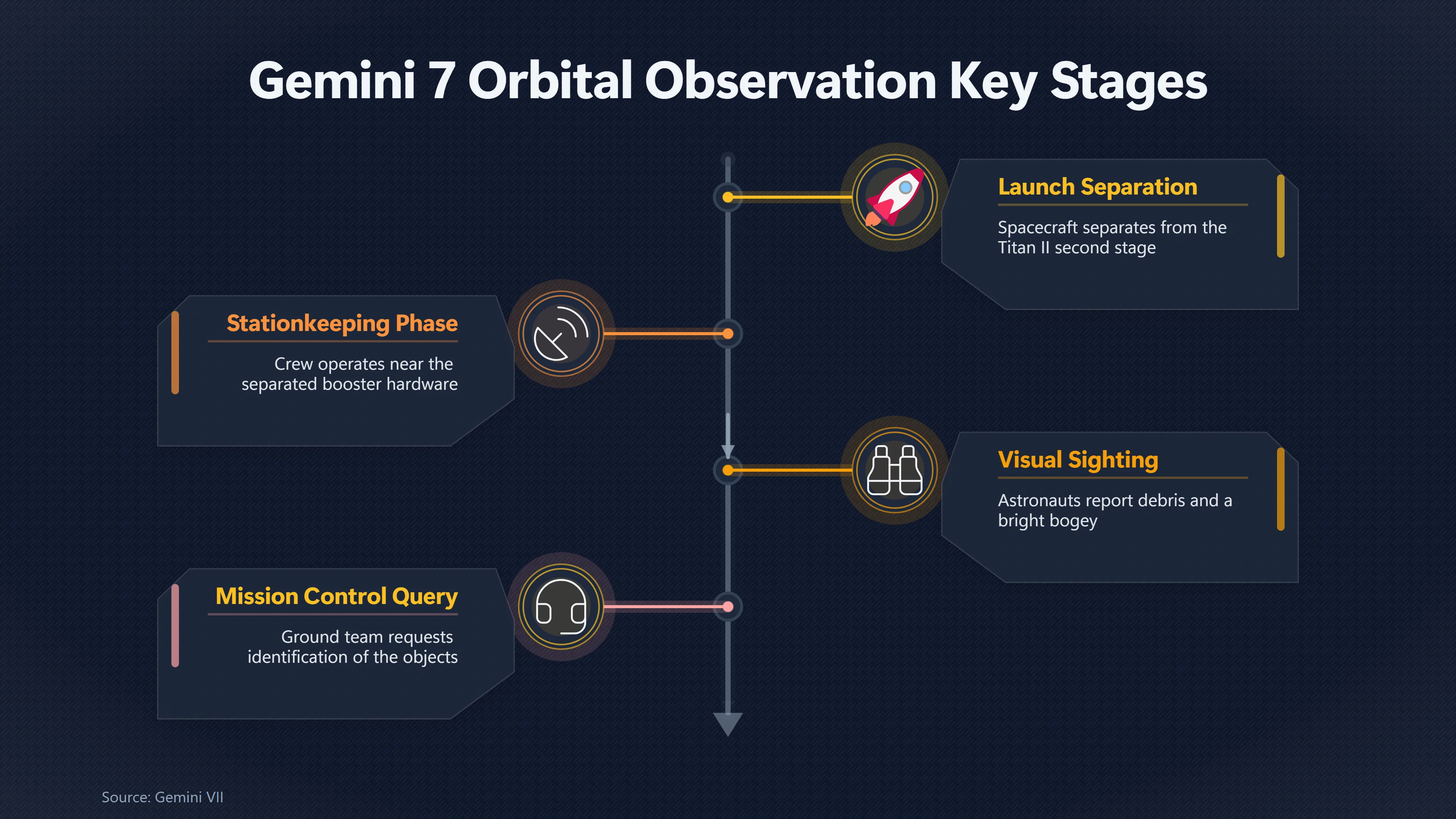
NASA’s Gemini VII mission records show that the spacecraft was inserted into a low Earth orbit of roughly 161.6 by 328.2 kilometres and that, immediately after separation, Gemini 7 operated in relation to the Titan II second stage. NASA’s mission history notes that the spacecraft conducted stationkeeping operations with the second stage, with separation distances ranging from metres to many kilometres during the early phase of flight.[NASA]nasa.govGemini VIIGemini VII - NASANovember 18, 2025… This created exactly the type of setting where a crew could see several related objects moving independently.
The recorded communications also show that the astronauts themselves recognised multiple categories of objects. Mission Control asked whether the sighting involved the booster, and Borman distinguished between the booster, debris, and the unidentified object he called a “bogey”. The transcript records Borman reporting debris and describing many small particles near the spacecraft, while Lovell described a bright object against the dark background of space.[UFO Transparency]ufotransparency.comnasa uap d3 gemini 7 transcript 1965UFO TransparencyBorman's 'Bogey,' Gemini 7 Transcript 1965, NASA · UFO Transparency…
This distinction is important. The debris explanation does not require that the astronauts mistook every object they saw for the booster. A more realistic scenario is that several ordinary objects were present at once: the spent launch stage, smaller fragments, and a reflective piece of hardware whose appearance was difficult to judge from a moving spacecraft.
Launch hardware and separation events
The Titan II Gemini launch system was a complex collection of large components, and separation was not a single instant in which all hardware vanished from the spacecraft’s vicinity. The second stage had completed its job, but it remained an orbiting object. Earlier Gemini mission documentation describes the close relationship between spacecraft and launch vehicle hardware after insertion, including planned observations and manoeuvres around the separated stage.[NASA]nasa.govProject GeminiProject Gemini - A Chronology. Part 3 (A)…
Several physical effects could make launch debris appear unusual:
- Different orbital paths: Once separated, the spacecraft and booster no longer shared exactly the same orbit. Even a small difference in speed or direction could cause one object to appear to move ahead, fall behind, or drift sideways.
- Rotation: Uncontrolled pieces of hardware can tumble. A rotating surface may repeatedly catch sunlight and produce flashes or changes in brightness.
- Low visual contrast: Against the blackness of space, a sunlit object has no familiar background reference, making distance and size difficult to estimate.
- Multiple nearby objects: A cloud of small fragments can make one bright object appear surrounded by activity.
NASA’s later work on orbital debris observation has demonstrated that large and small objects in orbit can be studied through their reflected sunlight and that the brightness of debris depends strongly on surface orientation and motion.[Orbital Debris Program Office]orbitaldebris.jsc.nasa.govOpen source on nasa.gov.
Reflective Objects in Low Earth Orbit
A major source of confusion in space sightings is that objects do not need to be large to appear bright. In low Earth orbit, sunlight can illuminate spacecraft surfaces, insulation materials, frozen vapour, and fragments of metal. A small object in direct sunlight can look strikingly bright when viewed from a darkened spacecraft window.
This effect was especially relevant for Gemini 7 because the astronauts were observing from orbit rather than from Earth. Ground observers usually have atmospheric scattering, familiar horizons, and reference points that help estimate size and distance. Astronauts in orbit see objects against a nearly featureless black background, where a nearby fragment and a much larger distant object can produce similar visual impressions.
The “brilliant body” description from Lovell is therefore not, by itself, evidence for a large unknown craft. A reflective object rotating slowly can produce a dramatic appearance without possessing unusual characteristics. NASA studies of upper-stage objects in orbit have specifically examined how tumbling motion changes observed brightness, because rotating spacecraft bodies create changing light curves as different surfaces reflect sunlight.[NASA Technical Reports Server]ntrs.nasa.govNASA Technical Reports ServerLight Curve Observations of Upper Stages in the Low Earth Orbit Environment - NASA Technical Reports Server…
Modern orbital tracking also reinforces how deceptive appearances can be. NASA’s Orbital Debris Program Office uses optical observations of reflected sunlight to identify and characterise debris objects, demonstrating that many orbiting objects are detected primarily because they reflect light rather than because they are large or actively transmitting signals.[Orbital Debris Program Office]orbitaldebris.jsc.nasa.govOpen source on nasa.gov.
Why Space Observations Can Be Misleading
The Gemini 7 sighting illustrates a recurring problem in interpreting observations from space: trained observers can accurately report what they see while still being unable to determine what an object is.
Borman and Lovell were highly qualified witnesses. Their uncertainty was not caused by a lack of skill; it was caused by the difficulty of judging objects in orbital conditions. Astronauts are trained to operate spacecraft and report observations, but a visual estimate of a free-floating object’s distance, velocity, and size is extremely difficult without instruments or tracking data.
The conversation with Mission Control shows this process in action. Controllers asked practical identification questions: was the object the booster, debris, or something else? The crew attempted to separate the different visual targets. The exchange demonstrates a real-time identification problem rather than a simple mistake or a confirmed unknown technology.[UFO Transparency]ufotransparency.comnasa uap d3 gemini 7 transcript 1965UFO TransparencyBorman's 'Bogey,' Gemini 7 Transcript 1965, NASA · UFO Transparency…
Several factors made the observation especially vulnerable to misinterpretation:
- No fixed reference frame: A spacecraft in orbit is itself moving at roughly orbital velocity, so apparent motion does not directly reveal an object’s actual movement.
- Unknown distance: A small nearby fragment and a large distant object may appear similar in size.
- Sunlight effects: Bright reflections can make ordinary material look extraordinary.
- Short observation window: Without radar tracking or photographs, later investigators have limited physical evidence to analyse.

The Remaining Uncertainty
The debris explanation is strong because it fits the timing, environment, and known presence of spacecraft-related material. Gemini 7 had only recently separated from its launch vehicle, and the crew reported seeing debris during the same observation period.[NASA]nasa.govGemini VIIGemini VII - NASANovember 18, 2025…
However, the historical record does not provide a complete identification of every object seen by the astronauts. The transcript preserves what the crew observed, but it does not include a definitive tracking solution showing that every reported object was a specific piece of hardware. That gap is why the incident remains discussed.
The most balanced interpretation is that Gemini 7 involved a genuine observation of unidentified objects in orbit, but the orbital context supplies several ordinary mechanisms capable of producing the reported appearance. The case is valuable less as evidence for an unknown spacecraft than as an example of how familiar human technology, sunlight, and orbital mechanics can combine to create a puzzling sight even for expert observers.
Amazon book picks
Further Reading
Books and field guides related to Could Space Debris Explain Gemini 7?. Use these as the next step if you want deeper reading beyond the article.
Orbital Mechanics for Engineering Students
Orbital Mechanics for Engineering Students, Second Edition, provides an introduction to the basic concepts of space mechanics. These incl...
Carrying the Fire: An Astronaut's Journeys
'No other person who has flown in space has captured the experience so vividly' - New York Times Book Review In July 1969, Neil Armstrong...
The Right Stuff
Rating: 4.5/5 from 8 Google Books ratings
The first Americans in space--Yeager, Conrad, Grissom, and Glenn--battle the Russians for control of the heavens and put their lives on t...
Introduction to Rocket Science and Engineering
Introduction to Rocket Science and Engineering, Second Edition, presents the history and basics of rocket science, and examines design, e...
eBay marketplace picks
Marketplace Samples
Live-tested eBay searches with available results related to this page.
Selected fromspacecraft model oneBay.co.uk.
Endnotes
1.
Source: nasa.gov
Title: Gemini VII
Link:https://www.nasa.gov/mission/gemini-vii/
Source snippet
Gemini VII - NASANovember 18, 2025...
Published: November 18, 2025
2.
Source: orbitaldebris.jsc.nasa.gov
Link:https://orbitaldebris.jsc.nasa.gov/measurements/optical.html
3.
Source: nasa.gov
Title: Project Gemini
Link:https://www.nasa.gov/history/SP-4002/p3a.htm
Source snippet
Project Gemini - A Chronology. Part 3 (A)...
4.
Source: ntrs.nasa.gov
Link:https://ntrs.nasa.gov/citations/20120003597
Source snippet
NASA Technical Reports ServerLight Curve Observations of Upper Stages in the Low Earth Orbit Environment - NASA Technical Reports Server...
5.
Source: nasa.gov
Title: NAS A’s DART Mission Changed Orbit of Asteroid Didymos Around Sun
Link:https://www.nasa.gov/missions/dart/nasas-dart-mission-changed-orbit-of-asteroid-didymos-around-sun/
6.
Source: nasa.gov
Title: Gemini I
Link:https://www.nasa.gov/mission/gemini-i/
7.
Source: nasa.gov
Title: Gemini II
Link:https://www.nasa.gov/mission/gemini-ii/
8.
Source: nasa.gov
Title: 60 Years Ago: Uncrewed Gemini 2 Paves the Way for the First Crewed Mission
Link:https://www.nasa.gov/history/60-years-ago-uncrewed-gemini-2-paves-the-way-for-the-first-crewed-mission/
9.
Source: nasa.gov
Title: Project Gemini
Link:https://www.nasa.gov/gemini/
10.
Source: science.nasa.gov
Link:https://science.nasa.gov/mission/genesis/
11.
Source: science.nasa.gov
Title: pioneer 7
Link:https://science.nasa.gov/mission/pioneer-7/
12.
Source: nodis3.gsfc.nasa.gov
Title: display Dir.cfm
Link:https://nodis3.gsfc.nasa.gov/displayDir.cfm?Internal_ID=N_PR_8715006E&page_name=Chapter1
13.
Source: nasa.gov
Title: Space Debris
Link:https://www.nasa.gov/headquarters/library/find/bibliographies/space-debris/
14.
Source: nasa.gov
Title: Project Gemini
Link:https://www.nasa.gov/gallery/gemini/
15.
Source: nasa.gov
Title: 55 Years Ago: The Spirit of 76
Link:https://www.nasa.gov/history/55-years-ago-the-spirit-of-76-the-first-rendezvous-in-space/
16.
Source: nasa.gov
Title: Space Debris: Understanding the Risks to NASA Spacecraft
Link:https://www.nasa.gov/centers-and-facilities/nesc/space-debris-understanding-the-risks-to-nasa-spacecraft/
17.
Source: nasa.gov
Title: Micrometeoroids and Orbital Debris (MMOD)
Link:https://www.nasa.gov/centers-and-facilities/white-sands/micrometeoroids-and-orbital-debris-mmod/
18.
Source: nasa.gov
Title: Dual Gemini Flights Achieved Crucial Spaceflight Milestones
Link:https://www.nasa.gov/missions/gemini/dual-gemini-flights-achieved-crucial-spaceflight-milestones/
19.
Source: ntrs.nasa.gov
Link:https://ntrs.nasa.gov/citations/20130009086
20.
Source: ntrs.nasa.gov
Link:https://ntrs.nasa.gov/citations/20120012414
21.
Source: apod.nasa.gov
Link:https://apod.nasa.gov/apod/ap110314.html
22.
Source: science.nasa.gov
Title: space debris 40173
Link:https://science.nasa.gov/earth/earth-observatory/space-debris-40173/
23.
Source: science.nasa.gov
Title: catalog of earth satellite orbits
Link:https://science.nasa.gov/earth/earth-observatory/catalog-of-earth-satellite-orbits/
24.
Source: earthobservatory.nasa.gov
Title: space debris
Link:https://earthobservatory.nasa.gov/images/40173A/space-debris
25.
Source: orbitaldebris.jsc.nasa.gov
Link:https://orbitaldebris.jsc.nasa.gov/faq/
26.
Source: orbitaldebris.jsc.nasa.gov
Link:https://www.orbitaldebris.jsc.nasa.gov/measurements/debrisat.html
27.
Source: nasa.gov
Title: Project Gemini
Link:https://www.nasa.gov/history/SP-4002/p2b.htm
28.
Source: nasa.gov
Title: Project Gemini
Link:https://www.nasa.gov/history/SP-4002/p2a.htm
29.
Source: nasa.gov
Title: Project Gemini
Link:https://www.nasa.gov/history/SP-4002/contents.htm
30.
Source: ntrs.nasa.gov
Link:https://ntrs.nasa.gov/archive/nasa/casi.ntrs.nasa.gov/19670095754.pdf
31.
Source: ntrs.nasa.gov
Link:https://ntrs.nasa.gov/citations/19730073399
32.
Source: ntrs.nasa.gov
Link:https://ntrs.nasa.gov/citations/19670095753
33.
Source: youtube.com
Title: Gemini 7
Link:https://www.youtube.com/watch?v=4wNSJXegWg8
Source snippet
"We just saw BOGEY & BRILLIANT space object…": UFO files reveal Gemini 7 astronauts' 1965 sighting...
34.
Source: ufotransparency.com
Title: nasa uap d3 gemini 7 transcript 1965
Link:https://ufotransparency.com/files/nasa-uap-d3-gemini-7-transcript-1965
Source snippet
UFO TransparencyBorman's 'Bogey,' Gemini 7 Transcript 1965, NASA · UFO Transparency...
35.
Source: alien.net
Title: r01 020 nasa uap d3 gemini 7 transcript 1965
Link:https://alien.net/disclosure/cases/r01-020-nasa-uap-d3-gemini-7-transcript-1965
Source snippet
NASA-UAP-D3, Gemini 7 Transcript, 1965 | alien.netMay 8, 2026 — Case file · wargov-r01-020-nasa-uap-d3-gemini-7-transcript-1965 NASA-UAP...
Published: May 8, 2026
36.
Source: spacefacts.de
Title: gemini 7
Link:https://www.spacefacts.de/mission/english/gemini-7.htm
37.
Source: govweird.com
Title: nasa uap d3 gemini 7 transcript 1965
Link:https://www.govweird.com/topics/ufo/dow-pursue/nasa-uap-d3-gemini-7-transcript-1965
38.
Source: ufotransparency.com
Title: nasa uap d3a gemini 7 audio excerpt 1965
Link:https://ufotransparency.com/files/nasa-uap-d3a-gemini-7-audio-excerpt-1965
Additional References
39.
Source: phys.org
Link:https://phys.org/news/2026-05-pentagon-ufo-apollo-moon-missions.html
Source snippet
Pentagon releases UFO files that go back to the Apollo moon missionsMay 11, 2026 — "Additional files will be released by the Department o...
Published: May 11, 2026
40.
Source: spookstack.io
Title: 6042 nasa uap d3 gemini 7 transcript 1965
Link:https://spookstack.io/documents/6042-nasa-uap-d3-gemini-7-transcript-1965/
Source snippet
NASA-UAP-D3, Gemini 7 Transcript, 1965 — SpookStackMay 10, 2026 — NASA-UAP-D3, GEMINI 7 TRANSCRIPT, 1965 4 pages · May 10, 2026 · Broad t...
Published: May 10, 2026
41.
Source: galacticanthropologysidenotes.wordpress.com
Title: ufo sighting by borman gemini 7 1965
Link:https://galacticanthropologysidenotes.wordpress.com/2026/05/11/ufo-sighting-by-borman-gemini-7-1965/
Source snippet
Sighting by Borman – Gemini 7 – 1965 – Galactic Anthropology – SidenotesMay 11, 2026 — UFO SIGHTING BY BORMAN – GEMINI 7 – 1965 Published...
Published: May 11, 2026
42.
Source: youtube.com
Link:https://www.youtube.com/watch?v=yz5YidDoD0I
Source snippet
GEMINI VII AND GEMINI VI QUICK LOOK ” 1965 NASA GEMINI PROGRAM DOCUMENTARY...
43.
Source: youtube.com
Link:https://www.youtube.com/watch?v=dx1N6LPn0ag
Source snippet
Gemini 6 & 7: The First Space Rendezvous (1965) | Historic NASA Footage...
44.
Source: youtube.com
Link:https://www.youtube.com/watch?v=UprbucDk0Ho
Source snippet
Proud Conquest: Gemini VII and VI (1966)...
45.
Source: scribd.com
Link:https://www.scribd.com/document/192717159/Final-Report-of-the-Scientific-Study-of-Unidentified-Flying-Objects
46.
Source: spaceline.org
Link:https://www.spaceline.org/united-states-manned-space-flight/gemini-mission-program-index/gemini-7-fact-sheet/
47.
Source: uforeleases.com
Link:https://uforeleases.com/topics/state-dept-nasa/255_t_763_r1b_transcripts
48.
Source: lemonde.fr
Link:https://www.lemonde.fr/archives/article/1965/12/20/apres-un-vol-de-plus-de-350-heures-la-cabine-gemini-7-est-redescendue-a-son-tour-sur-terre_3068994_1819218.html