Within Bonilla Observation
Could Birds Explain the Solar Shapes?
Atmospheric objects near the telescope remain a leading explanation because birds, insects, or debris could create dark solar silhouettes.
On this page
- How solar photography creates silhouettes
- Atmospheric objects near telescopes
- Why distant objects face challenges
Page outline Jump by section
Introduction
The bird, insect, and telescope-view explanation is one of the oldest interpretations of the José A. y Bonilla photograph of 1883. It argues that the dark shapes recorded crossing the Sun were not distant objects in space, but ordinary material close to the telescope’s optical path. In this view, birds, insects, dust, or other nearby debris could have produced large dark silhouettes when photographed against the extremely bright solar disc. The idea was not a modern attempt to dismiss the observation: it was already considered during the original 19th-century discussion of Bonilla’s report, particularly because nearby objects could explain why the phenomenon was recorded from one observatory but not widely observed elsewhere.
Wikipedia
The explanation remains important because it addresses a central feature of the case: the photographs show that something crossed the telescope’s view, but they do not independently reveal the distance or nature of those objects. A small object near the telescope and a much larger object far away can both appear as silhouettes when viewed against the Sun. The debate therefore depends on optical geometry, the appearance of the images, and the consistency of the reported motion rather than on the photographs alone.
Wikipedia
How solar photography creates silhouettes
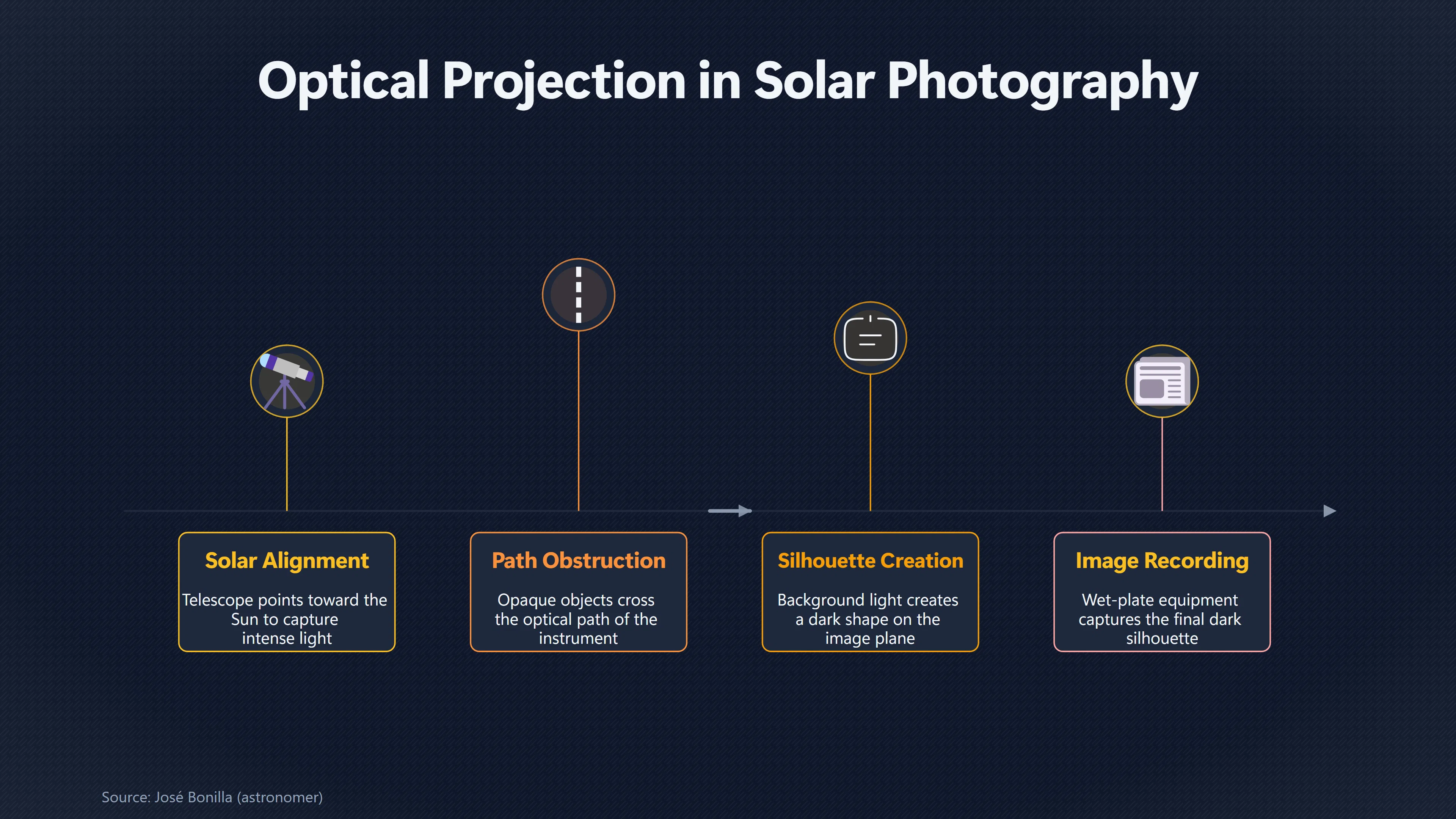
When an astronomical telescope is pointed at the Sun, the image is dominated by an intense background of light. Any opaque object crossing the optical path can block that light and appear as a dark shape. The object does not need to be large or unusual; it only needs to be positioned so that its silhouette is projected onto the telescope’s image plane.
For the Bonilla photographs, this creates a major uncertainty. A bird flying between the telescope and the Sun would not resemble a normal bird seen in the open sky. Instead, the telescope would magnify its outline against the bright solar background, potentially making wings, body shape, or motion trails appear as strange dark forms. The same principle applies to insects or floating particles very close to the instrument.
This kind of effect is familiar in modern solar imaging. Photographers occasionally capture aircraft, birds, or other objects crossing the Sun while using telescopes or long-focus lenses, producing silhouettes that can look like unexpected astronomical bodies if the context is removed. Contemporary solar photographers have documented aircraft transiting the Sun’s disc during high-resolution observations, demonstrating how ordinary atmospheric objects can briefly imitate unusual solar phenomena.
The 1883 observation also took place with wet-plate photographic equipment, which was far less capable than modern digital systems. The resulting images preserved dark shapes but not fine identifying details. Bonilla described some forms as indistinct or mist-like and reported features such as dark trails, but the surviving photographic record does not provide enough resolution to identify a precise object type.
Wikipedia
Could birds or insects match Bonilla’s observations?
The strongest argument for birds or insects comes from the viewing geometry. If the objects were close to the telescope, they could explain several otherwise puzzling aspects of the event:
Large apparent size: A small insect near the telescope can cover a noticeable portion of the Sun’s image, while a distant object would need to be much larger.
Dark silhouettes: A nearby opaque object naturally produces a sharp contrast against the solar disc.
Limited geographic visibility: An object close to one observatory might only cross the Sun from that particular location, explaining why other observers did not report the same event.
Irregular forms: Wings, bodies, and movement could create changing shapes that would not resemble conventional astronomical objects.
The original publication of Bonilla’s observations in L’Astronomie in 1886 did not establish a definitive cause. However, editor Camille Flammarion and others considered ordinary explanations such as birds, insects, or dust because a nearby object offered a straightforward optical explanation.

Wikipedia
There are also challenges. Bonilla reported a large number of objects over his observation period, with hundreds recorded on photographic plates. Critics of the bird or insect explanation argue that a prolonged sequence of transits would require a very specific combination of circumstances: many objects passing through the telescope’s narrow field of view at the correct time and direction.
Wikipedia
However, the difficulty is not impossible. The telescope was aimed at the Sun, a target that occupies a fixed position in the sky for observation. Any local object crossing the line of sight could create a recorded event. The key unresolved question is whether the frequency and appearance of the shapes better match nearby airborne objects or something farther away.
Why telescope distance changes the interpretation
Distance is the central issue in evaluating the Bonilla photographs. A telescope does not automatically reveal how far away an object is. It records an image created by light passing through the optical system, and objects at very different distances can appear similar if they produce the same projected silhouette.
A bird a few hundred metres from the telescope and a large object thousands of kilometres away could both appear as dark shapes on a photographic plate. The difference would need to be established through additional evidence, such as simultaneous observations from different locations, measurable motion, or reliable estimates of size and distance.
This is why the absence of widespread confirmation has been important in the debate. If the objects were large astronomical bodies crossing the Sun, other observatories might have been expected to detect them. Supporters of more distant explanations have argued that viewing geometry could prevent other locations from seeing the same alignment, but the lack of independent observations remains a significant limitation.[Spooky Valley]spookyvalley.comSpooky Valley José Bonilla UFO Observation | Spooky ValleySpooky ValleyJosé Bonilla UFO Observation | Spooky ValleyJuly 12, 2026…
The later comet-fragment proposal and the remaining debate
The bird and insect explanation was not the only natural interpretation. In 2011, researchers from the National Autonomous University of Mexico proposed that Bonilla may have photographed fragments of a disintegrating comet passing unusually close to Earth. Their model attempted to explain the number of objects, their apparent movement, and the reported shapes by treating them as pieces of a fragmented comet rather than atmospheric objects.[arXiv]arxiv.orgInterpretation of the observations made in 1883 in Zacatecas (Mexico): A fragmented Comet that nearly hits the EarthOctober 12, 2011…
This later hypothesis changed the discussion because it offered a possible explanation for features that some researchers considered difficult for birds or insects, including the large number of recorded objects and some reported trails or mist-like appearances. However, the comet interpretation also requires assumptions about a very unusual near-Earth event, and it remains a debated reconstruction rather than a direct identification from the photographs themselves.[arXiv]arxiv.orgInterpretation of the observations made in 1883 in Zacatecas (Mexico): A fragmented Comet that nearly hits the EarthOctober 12, 2011…
The importance of the bird, insect, and telescope-view explanation is therefore not that it conclusively solves the Bonilla mystery. Its significance is that it highlights a basic principle of astronomical imaging: a photograph records an optical projection, not an automatic measurement of distance. For the 1883 images, the central question is not whether Bonilla photographed real objects — he almost certainly did — but whether those objects were nearby visitors to the telescope’s field of view or distant phenomena crossing the Sun. Wikipedia
Amazon book picks
Further Reading
Books and field guides related to Could Birds Explain the Solar Shapes?. Use these as the next step if you want deeper reading beyond the article.
Cosmos
The best-selling science book ever published in the English language, COSMOS is a magnificent overview of the past, present, and future o...
Light: Science and Magic: An Introduction to Photographic Lig...
This book is renowned for being the book to own to understand lighting! This is better than all the other how to books on the market whic...
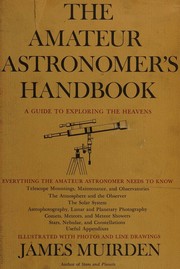
The Amateur Astronomer's Handbook
First published 1968. Subjects: Observers' manuals, Astronomy, Amateurs' manuals.
eBay marketplace picks
Marketplace Samples
Live-tested eBay searches with available results related to this page.
Selected fromtelescope accessory oneBay.co.uk.

Endnotes
1.
Source: Wikipedia
Title: José Bonilla (astronomer)
Link:https://en.wikipedia.org/wiki/Jos%C3%A9Bonilla%28astronomer%29
2.
Source: Wikipedia
Title: Bonilla observation
Link:https://en.wikipedia.org/wiki/Bonilla_observation
3.
Source: reddit.com
Link:https://www.reddit.com/r/space/comments/16qgr85
Source snippet
While observing the sun through my telescope, I was photobombed by a passing plane, completely by chance. in comments...
4.
Source: reddit.com
Title: Photobombed by a plane while photographing the sun
Link:https://www.reddit.com/r/astrophotography/comments/16qgu3e
Source snippet
Photobombed by a plane while photographing the sun...
5.
Source: arxiv.org
Link:https://arxiv.org/abs/1110.2798
Source snippet
Interpretation of the observations made in 1883 in Zacatecas (Mexico): A fragmented Comet that nearly hits the EarthOctober 12, 2011...
Published: October 12, 2011
6.
Source: nature.com
Title: The Observation of Meteors | Nature
Link:https://www.nature.com/articles/029006c0.pdf
7.
Source: nature.com
Title: ASTRONOMICA L PHOTOGRAPHY | Nature
Link:https://www.nature.com/articles/027556c0.pdf
8.
Source: spookyvalley.com
Title: Spooky Valley José Bonilla UFO Observation | Spooky Valley
Link:https://spookyvalley.com/events/1883-jose-bonilla-observation/
Source snippet
Spooky ValleyJosé Bonilla UFO Observation | Spooky ValleyJuly 12, 2026...
Published: July 12, 2026
9.
Source: sis-group.org.uk
Link:https://www.sis-group.org.uk/news/2023/01/12/bonilla/
10.
Source: eclipse.gsfc.nasa.gov
Link:https://eclipse.gsfc.nasa.gov/SEpubs/19970309/text/photography.html
11.
Source: eclipse.gsfc.nasa.gov
Link:https://eclipse.gsfc.nasa.gov/SEpubs/19951024/text/photography.html
12.
Source: eclipse.gsfc.nasa.gov
Link:https://eclipse.gsfc.nasa.gov/SEpubs/19980226/text/photography.html
Additional References
13.
Source: researchgate.net
Link:https://www.researchgate.net/publication/51945342_Interpretation_of_the_observations_made_in_1883_in_Zacatecas_Mexico_Afragmented_Comet_that_nearly_hits_the_Earth
Source snippet
ResearchGate(PDF) Interpretation of the observations made in 1883 in Zacatecas (Mexico): A fragmented Comet that nearly hits the Earth...
14.
Source: spaceref.com
Link:https://spaceref.com/status-report/interpretation-of-the-observations-made-in-1883-in-zacatecas-a-fragmented-comet-that-nearly-hits-the-earth/
Source snippet
Interpretation of the observations made in 1883 in Zacatecas: A fragmented Comet that nearly hits the Earth - SpaceRef...
15.
Source: news.cnrs.fr
Title: fr From popular astronomy to astrophysics | CNRS News
Link:https://news.cnrs.fr/articles/from-popular-astronomy-to-astrophysics
Source snippet
popular astronomy to astrophysics | CNRS NewsJanuary 16, 2026 — FROM POPULAR ASTRONOMY TO ASTROPHYSICS YOU ARE HERE Lire en français Spac...
Published: January 16, 2026
16.
Source: skyandtelescope.org
Title: Solar Photography: Catch the Sun
Link:https://skyandtelescope.org/astronomy-resources/solar-photography-catch-the-sun/
Source snippet
Image: Catching the Sun | Sky & TelescopeHEATING UP Solar Cycle 25 is roaring to life, making this a great time to experience the excitem...
17.
Source: youtube.com
Title: Watch the Sun “Melt” into the Gulf
Link:https://www.youtube.com/watch?v=jVYufdztQJY
Source snippet
The First UFO Photographs in History — What They Really Captured in 1883 is directly relevant because it analyzes José A. y Bonilla's 188...
18.
Source: researchgate.net
Link:https://www.researchgate.net/publication/389325666_Pratiques_photographiques_amateures_a_la_Societe_astronomique_de_France_1882-1915_diffusion_apprentissage_et_professionnalisation
19.
Source: societescientifiqueflammarion.asso.fr
Link:https://www.societescientifiqueflammarion.asso.fr/node/14
20.
Source: discovermagazine.com
Link:https://www.discovermagazine.com/did-a-fragmenting-comet-nearly-hit-the-earth-in-1883-color-me-very-skeptical-23066
21.
Source: youtube.com
Title: UFOs Are Older Than You Think
Link:https://www.youtube.com/watch?v=MwHiDSozV6g
Source snippet
Seestar s50! Bird caught flying in front of the Sun and a UAP...
22.
Source: africsis.org
Title: reanalysis of 1883 observations suggests a billion ton comet buzzed earth
Link:https://africsis.org/reanalysis-of-1883-observations-suggests-a-billion-ton-comet-buzzed-earth/