Within Gemini IV Mystery
Was the Gemini IV Object Space Debris?
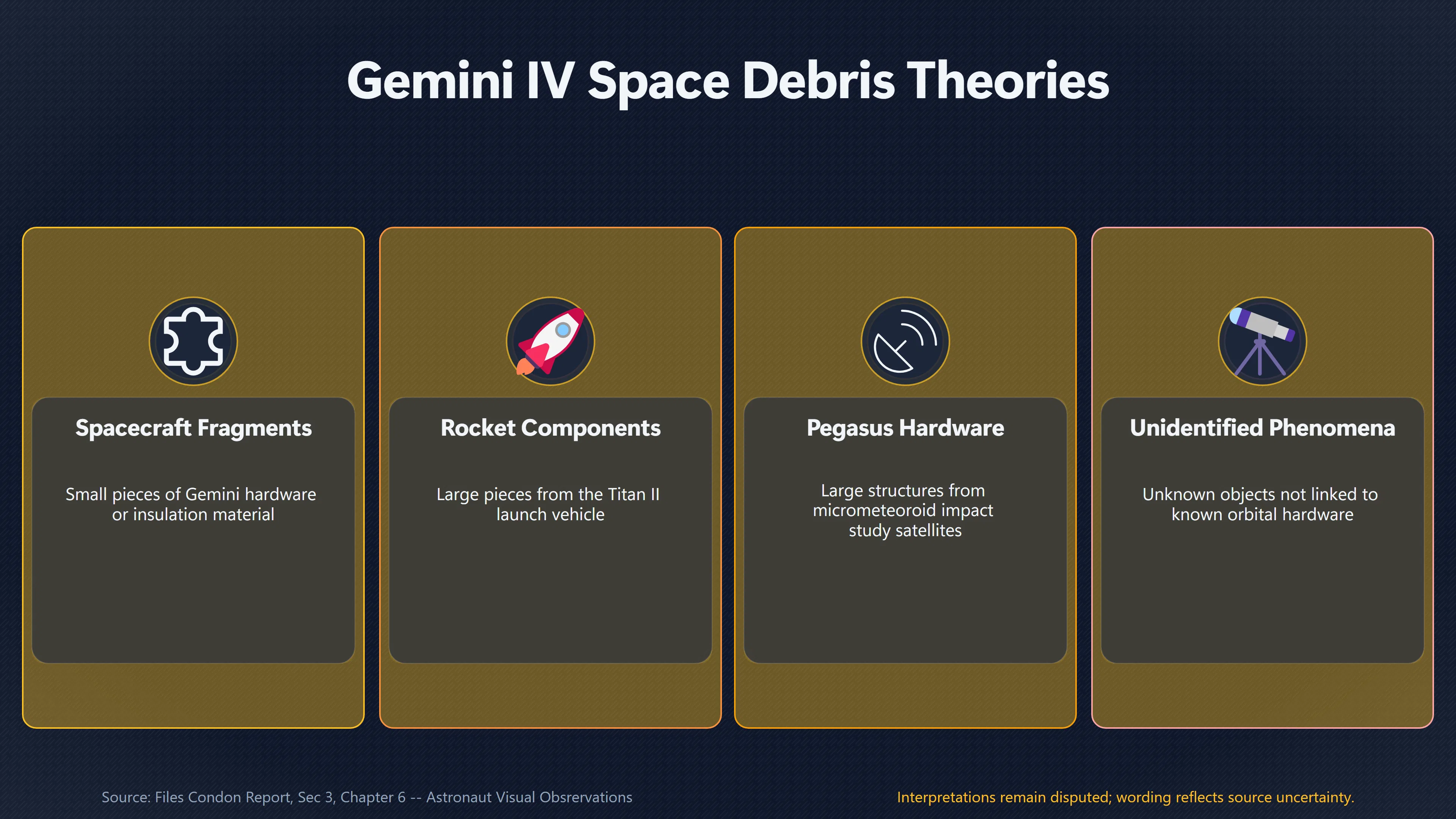
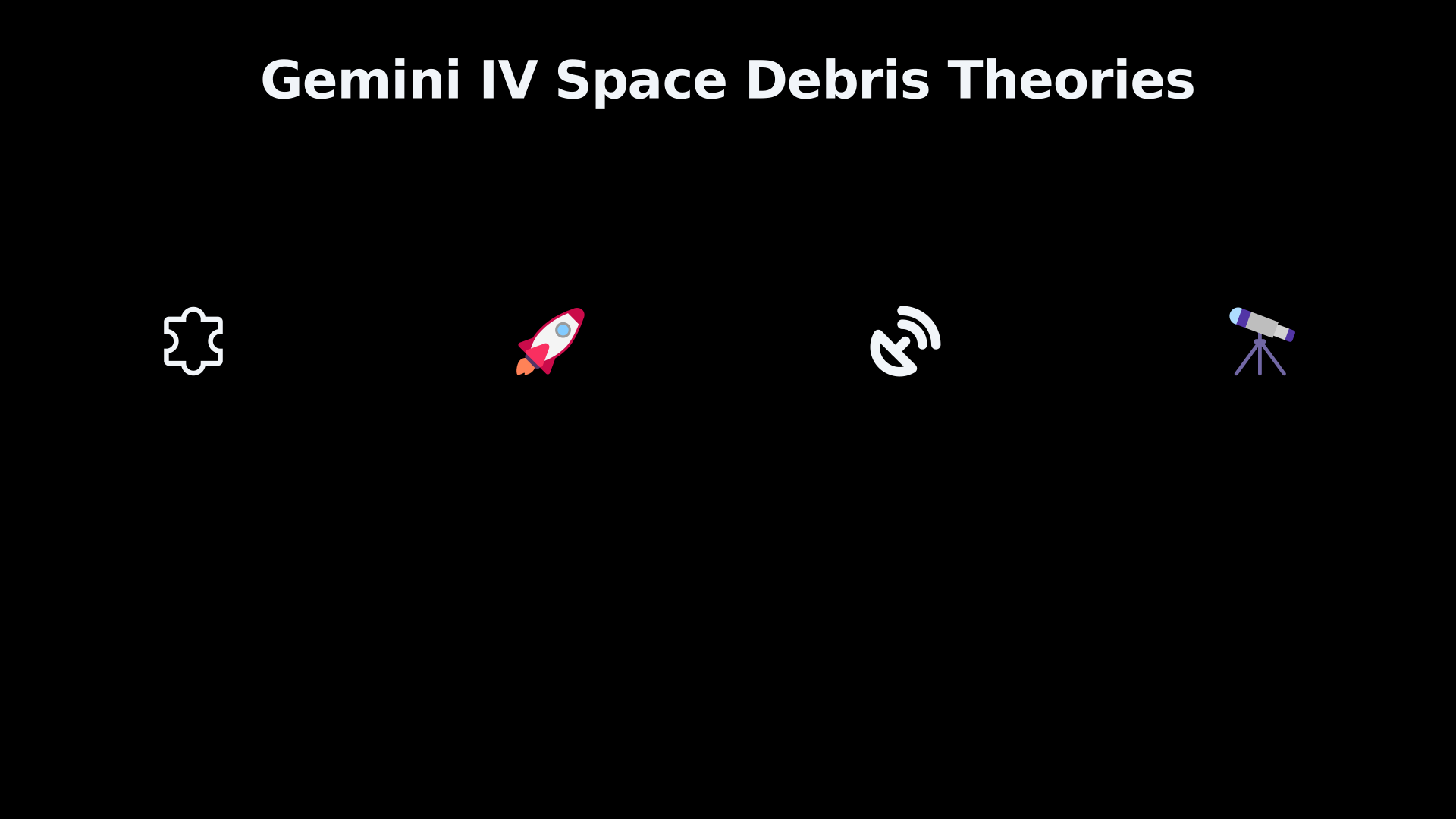
Possible debris and spacecraft hardware explanations remain among the strongest conventional interpretations of the unidentified object.
On this page
- Possible spacecraft related materials
- Rocket hardware explanations
- Why no identification was confirmed
Page outline Jump by section
Introduction
The space-debris explanation for the Gemini IV object is one of the strongest conventional interpretations because the sighting occurred during a period when the spacecraft was surrounded by recently launched hardware, discarded components, and other orbital fragments. Astronaut James McDivitt saw a white, cylindrical-looking object with a protruding feature on 4 June 1965, but the available evidence has never produced a confirmed identification. The leading debris theories do not require the object to have been an unknown spacecraft or an extraordinary phenomenon: they propose that McDivitt may have seen a piece of Gemini-era flight hardware, rocket material, insulation, or another fragment reflecting sunlight in orbit.[NCAS Files]files.ncas.orgFiles Condon Report, Sec 3, Chapter 6 – Astronaut Visual ObsrervationsNCAS FilesCondon Report, Sec 3, Chapter 6 – Astronaut Visual Obsrervations…
The difficulty is that “space debris” covers several different possibilities. Some candidate objects can be linked directly to the Gemini IV launch vehicle or spacecraft; others involve small fragments that were not tracked or catalogued. The debate has therefore centred less on whether debris existed near Gemini IV and more on whether any known object matched the size, shape, distance, and appearance described by McDivitt.[NCAS Files]files.ncas.orgFiles Condon Report, Sec 3, Chapter 6 – Astronaut Visual ObsrervationsNCAS FilesCondon Report, Sec 3, Chapter 6 – Astronaut Visual Obsrervations…
Possible spacecraft-related materials
The Gemini IV mission operated in an environment where loose hardware was a realistic possibility. The spacecraft had recently separated from its launch vehicle, and NASA’s early crewed missions were still learning how much small material could remain nearby after launch. Gemini IV also attempted a rendezvous exercise with the Titan II second stage during the mission, placing the crew in a situation where rocket hardware was a relevant part of the operational environment.[NASA]nasa.govGemini IV: Learning to Walk in SpaceGemini IV: Learning to Walk in Space - NASAJune 1, 2015…
A simple debris explanation is that McDivitt saw a small object shed from either the Gemini spacecraft or associated launch equipment. In orbit, even a lightweight fragment can become visually striking because a reflective surface can flash brightly when it catches sunlight. Without atmospheric depth cues, astronauts had limited ability to judge whether an object was a nearby piece of material only a few metres away or a much larger object hundreds of kilometres distant. This uncertainty is central to interpreting the Gemini IV sighting.[NCAS Files]files.ncas.orgFiles Condon Report, Sec 3, Chapter 6 – Astronaut Visual ObsrervationsNCAS FilesCondon Report, Sec 3, Chapter 6 – Astronaut Visual Obsrervations…
Later analysts have suggested that fragments such as insulation material, straps, or other spacecraft-related pieces could have produced an appearance resembling McDivitt’s description of a white cylinder with an extension. Spaceflight writer James Oberg, for example, argued that small pieces of spacecraft material were a plausible explanation and later favoured a fragment from the Gemini spacecraft rather than the Titan booster explanation.[James Oberg]jamesoberg.comOpen source on jamesoberg.com.
This interpretation gained support from experience with later Gemini flights. Photographs and observations from subsequent missions showed that spacecraft could have loose-looking external materials and small objects drifting nearby. The early Gemini programme had limited experience with how visually confusing such fragments could appear against the black background of space.[Reddit]reddit.com16 "Out of This World" (the episode where Peter and Bobby think they see a UFO in their backyard).January 10, 2023…
Rocket hardware explanations
The most famous debris candidate has been the Titan II second stage, the rocket component that launched Gemini IV into orbit. Because the object McDivitt described was cylindrical with a projecting feature, some analysts noted that a rocket stage could produce a similar general impression. The Titan stage was also a known object associated with the mission, making it a natural first candidate for investigators.[NCAS Files]files.ncas.orgFiles Condon Report, Sec 3, Chapter 6 – Astronaut Visual ObsrervationsNCAS FilesCondon Report, Sec 3, Chapter 6 – Astronaut Visual Obsrervations…
However, the Titan II explanation has important problems. McDivitt had already spent considerable time observing the booster during the mission’s attempted rendezvous activities and later said that the object he saw was not the Titan second stage. When shown a photograph of the Titan stage, he identified it as the rocket hardware but stated that it was not the object he had reported seeing.[James Oberg]jamesoberg.comOpen source on jamesoberg.com.
The distinction matters because a known rocket component and the unknown object were not necessarily the same thing. A spacecraft commander familiar with his own vehicle’s booster is unlikely to confuse a large nearby stage with an unrelated object, although human perception in orbit remains imperfect. The Titan theory therefore remains a plausible historical attempt at identification, but not a confirmed solution.[James Oberg]jamesoberg.comOpen source on jamesoberg.com.
Another early possibility considered was Pegasus-related hardware. The Pegasus satellites were large structures launched by modified rockets to study micrometeoroid impacts, and their broad shapes made them appear superficially relevant. However, the Condon Report analysis found that the known Pegasus object was too distant at the reported time to match the apparent angular size and structural detail described by McDivitt.[NCAS Files]files.ncas.orgFiles Condon Report, Sec 3, Chapter 6 – Astronaut Visual ObsrervationsNCAS FilesCondon Report, Sec 3, Chapter 6 – Astronaut Visual Obsrervations…
Why no identification was confirmed
The main obstacle for a debris explanation is not a shortage of possible objects; it is the lack of enough precise information to match one object conclusively. McDivitt provided a description of shape and appearance, but he could not determine the object’s exact distance or size. In space, that missing information is critical because a small nearby fragment and a large distant spacecraft component can appear surprisingly similar.[NCAS Files]files.ncas.orgFiles Condon Report, Sec 3, Chapter 6 – Astronaut Visual ObsrervationsNCAS FilesCondon Report, Sec 3, Chapter 6 – Astronaut Visual Obsrervations…
Tracking data from 1965 also had limitations. The Condon Report examined known objects near Gemini IV and found several fragments and pieces of hardware in the area, but none clearly matched the observation. Some objects were too distant, too small, or otherwise inconsistent with the reported appearance.[NCAS Files]files.ncas.orgFiles Condon Report, Sec 3, Chapter 6 – Astronaut Visual ObsrervationsNCAS FilesCondon Report, Sec 3, Chapter 6 – Astronaut Visual Obsrervations…
The photographs taken during the encounter did not resolve the issue. They were not sufficiently clear to establish the object’s identity, leaving investigators dependent on McDivitt’s visual account and orbital records. This created a situation where debris remained the leading conventional category of explanation without producing a definitive match.[Think About It Docs]thinkaboutitdocs.comgemini 4 astronaut james mcdivitt sighting object spaceThink About It Docs1965: Gemini 4 - Astronaut James McDivitt sighting of object in space…
The strongest assessment is therefore cautious: the Gemini IV object may well have been ordinary spacecraft-related material, but no specific piece of debris has been proven to be the object McDivitt saw. The case remains interesting because it demonstrates a genuine problem in early human spaceflight observation — astronauts could make careful observations, yet the orbital environment contained many unfamiliar and difficult-to-track objects that could mimic something unusual.[NCAS Files]files.ncas.orgFiles Condon Report, Sec 3, Chapter 6 – Astronaut Visual ObsrervationsNCAS FilesCondon Report, Sec 3, Chapter 6 – Astronaut Visual Obsrervations…
Amazon book picks
Further Reading
Books and field guides related to Was the Gemini IV Object Space Debris?. Use these as the next step if you want deeper reading beyond the article.
The Right Stuff
Rating: 4.5/5 from 8 Google Books ratings
The first Americans in space--Yeager, Conrad, Grissom, and Glenn--battle the Russians for control of the heavens and put their lives on t...
Carrying the Fire: An Astronaut's Journeys
'No other person who has flown in space has captured the experience so vividly' - New York Times Book Review In July 1969, Neil Armstrong...
Orbital Mechanics for Engineering Students
Orbital Mechanics for Engineering Students, Second Edition, provides an introduction to the basic concepts of space mechanics. These incl...
The Case for Mars: The Plan to Settle the Red Planet and Why...
He explains step-by-step how we can use present-day technology to send humans to Mars within ten years; actually produce fuel and oxygen...
eBay marketplace picks
Marketplace Samples
Live-tested eBay searches with available results related to this page.
Selected fromspacecraft model oneBay.co.uk.
Endnotes
1.
Source: files.ncas.org
Title: Files Condon Report, Sec 3, Chapter 6 – Astronaut Visual Obsrervations
Link:https://files.ncas.org/condon/text/s3chap06.htm
Source snippet
NCAS FilesCondon Report, Sec 3, Chapter 6 -- Astronaut Visual Obsrervations...
2.
Source: nasa.gov
Title: Gemini IV
Link:https://www.nasa.gov/mission/gemini-iv/
Source snippet
Gemini IV - NASA...
3.
Source: nasa.gov
Title: Gemini IV: Learning to Walk in Space
Link:https://www.nasa.gov/history/gemini-iv-learning-to-walk-in-space-2/
Source snippet
Gemini IV: Learning to Walk in Space - NASAJune 1, 2015...
Published: June 1, 2015
4.
Source: reddit.com
Link:https://www.reddit.com/r/UFOs/comments/108cfh7
Source snippet
16 "Out of This World" (the episode where Peter and Bobby think they see a UFO in their backyard).January 10, 2023...
Published: January 10, 2023
5.
Source: starchild.gsfc.nasa.gov
Link:https://starchild.gsfc.nasa.gov/docs/StarChild/questions/question22.html
6.
Source: nasa.gov
Title: Project Gemini
Link:https://www.nasa.gov/history/SP-4002/p3a.htm
7.
Source: ntrs.nasa.gov
Link:https://ntrs.nasa.gov/search?q=gemini
8.
Source: nasa.gov
Link:https://www.nasa.gov/history/SP-4219/Chapter13.html
9.
Source: ntrs.nasa.gov
Link:https://ntrs.nasa.gov/citations/19670095754
10.
Source: jamesoberg.com
Link:https://www.jamesoberg.com/gemini4.html
11.
Source: thinkaboutitdocs.com
Title: gemini 4 astronaut james mcdivitt sighting object space
Link:https://www.thinkaboutitdocs.com/gemini-4-astronaut-james-mcdivitt-sighting-object-space/
Source snippet
Think About It Docs1965: Gemini 4 - Astronaut James McDivitt sighting of object in space...
12.
Source: jamesoberg.com
Title: James Oberg’s Pioneering Space
Link:https://www.jamesoberg.com/99faq.html
13.
Source: universetoday.com
Title: Gemini IV
Link:https://www.universetoday.com/articles/gemini-iv
14.
Source: jamesoberg.com
Title: James Oberg’s Pioneering Space
Link:https://www.jamesoberg.com/gemini7.html
15.
Source: nasa.fandom.com
Title: Gemini 4
Link:https://nasa.fandom.com/wiki/Gemini_4
16.
Source: military-history.fandom.com
Title: James Oberg
Link:https://military-history.fandom.com/wiki/James_Oberg
17.
Source: american-spacecraft.org
Link:https://www.american-spacecraft.org/documents/sp-4541/gemini.html
Additional References
18.
Source: signalsfromtheperiphery.com
Link:https://signalsfromtheperiphery.com/en/files/gemini-debriefings/
Source snippet
Much of the Gemini 4 visual material concerns the crew’s attempt to station-keep with their own spent Titan booster. James McDivitt...
19.
Source: sentinel-files.com
Title: nasa uap d017 preliminary gemini 4 crew debriefing part2 1965 sf 2026 000421
Link:https://www.sentinel-files.com/files/nasa-uap-d017-preliminary-gemini-4-crew-debriefing-part2-1965-sf-2026-000421
Source snippet
NASA-UAP-D017, Preliminary Gemini 4 Crew Debriefing, Part II, 1965 · Sentinel FilesJune 12, 2026 — SF-2026-000421 UnverifiedAliens & UAPs...
Published: June 12, 2026
20.
Source: youtube.com
Link:https://www.youtube.com/watch?v=_s2fuxoQ31Y
Source snippet
This selection of videos provides direct historical footage and documentary detail covering the Gemini 4 mission operations, launch maneu...
21.
Source: war-gov-ufo-release-1.vercel.app
Title: UF O — PURSUE Archive // U.S
Link:https://war-gov-ufo-release-1.vercel.app/
Source snippet
Department of WarJune 12, 2026 — NASA-UAP-D015, ASTRONAUT SCIENTIFIC DEBRIEFINGS, 1962-1963 This file contains memoranda, correspondence...
Published: June 12, 2026
22.
Source: youtube.com
Title: LAUNCH OF GEMINI IV
Link:https://www.youtube.com/watch?v=l6wzZTbYHRg
Source snippet
Crew Announcement Press Conference (1964, HD) full audio, training footage, Gemini IV...
Published: June 3, 1965
23.
Source: defense.gov
Link:https://www.defense.gov/News/News-Stories/Article/Article/3701297/dod-report-discounts-sightings-of-extraterrestrial-technology/
24.
Source: defense.gov
Link:https://www.defense.gov/News/News-Stories/Article/article/3368109/dod-working-to-better-understand-resolve-anomalous-phenomena/
25.
Source: defense.gov
Link:https://www.defense.gov/News/Releases/Release/Article/3700894/statement-by-pentagon-press-secretary-maj-gen-pat-ryder-on-the-historical-recor/
26.
Source: youtube.com
Link:https://www.youtube.com/watch?v=92qeHzlnmVk
Source snippet
LAUNCH OF GEMINI IV - June 3, 1965 - multiple angles...
Published: June 3, 1965
27.
Source: youtube.com
Title: Gemini IV Spacecraft: America’s first Spacewalk
Link:https://www.youtube.com/watch?v=qB0c77dre_M
Source snippet
Launch of the Gemini 4/Titan II on June 3, 1965 | NASA Archives...
Published: June 3, 1965