Within Tunguska
Was Tunguska an Asteroid or Comet?
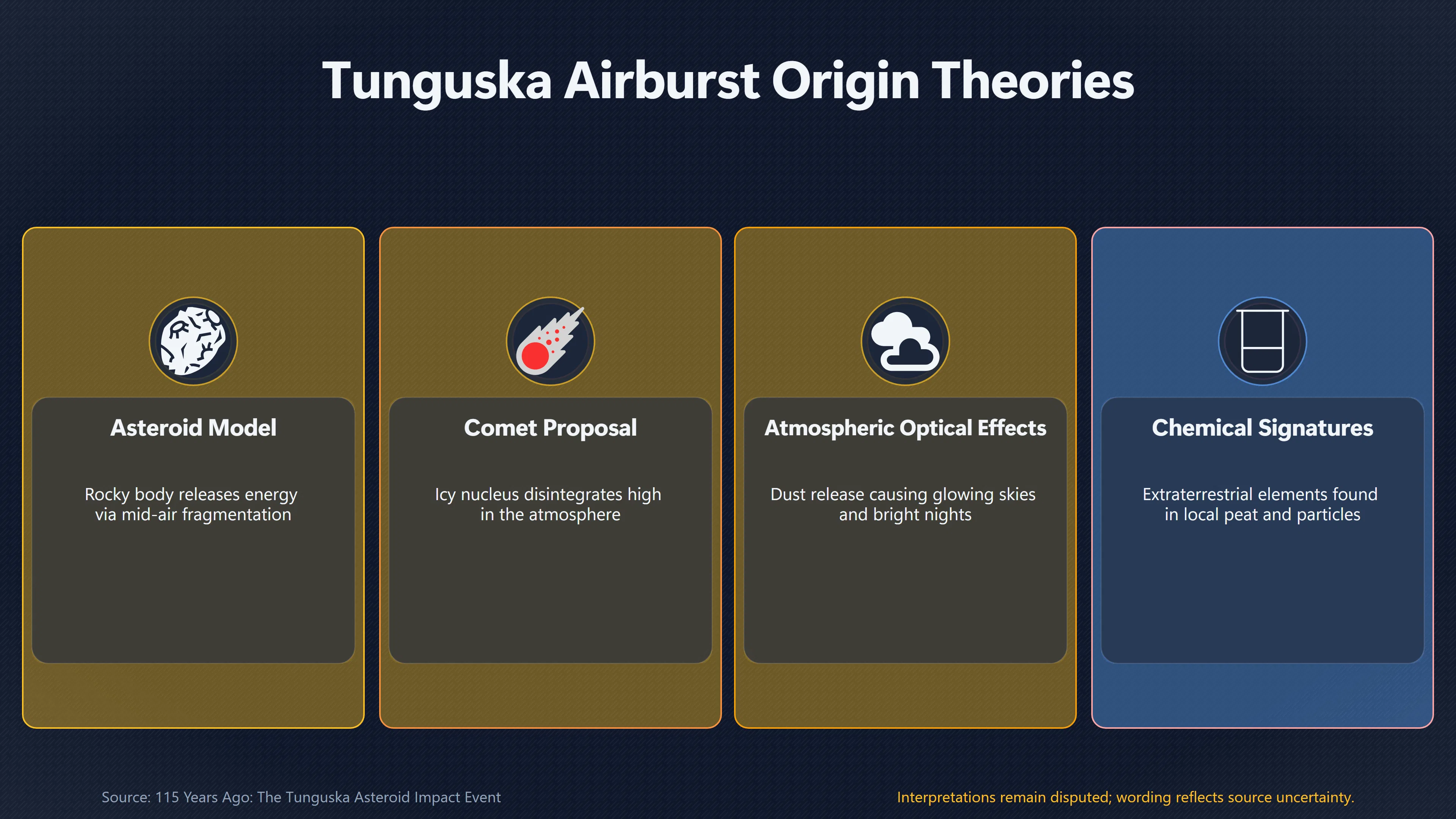
Scientists still study whether Tunguska came from an asteroid or comet, though both ideas involve a cosmic airburst.
On this page
- The asteroid explanation
- The comet proposal
- What evidence remains uncertain
Page outline Jump by section
Introduction
The Tunguska event of 1908 is widely accepted as a cosmic airburst, but the exact identity of the object that exploded above Siberia remains debated. The main scientific question is whether the Tunguska body was an asteroid — probably a stony or carbon-rich asteroid — or a comet fragment rich in ice and dust. Modern planetary scientists generally favour an asteroid explanation, especially a small asteroid that broke apart in the atmosphere, although some evidence and modelling studies have kept comet-based interpretations alive.[NASA]nasa.gov115 Years Ago: The Tunguska Asteroid Impact Event115 Years Ago: The Tunguska Asteroid Impact Event - NASAJune 30, 2023…
The distinction matters because asteroids and comets behave differently during atmospheric entry. Their strength, density, composition and fragmentation patterns affect how high they explode, how much material survives, and what chemical traces they leave behind. Tunguska provides an unusually difficult case because the object released enormous energy while leaving no confirmed large fragment or crater.[NASA Science]science.nasa.govScience A Cosmic Explosion Over SiberiaNASA ScienceA Cosmic Explosion Over Siberia - NASA ScienceJune 30, 2025…
The asteroid explanation
The strongest modern interpretation is that Tunguska was caused by a rocky asteroid entering Earth’s atmosphere at high speed and exploding before reaching the ground. NASA describes the event as an asteroid airburst and notes that later studies found the evidence most consistent with a mid-air explosion that destroyed the object rather than a conventional surface impact.[NASA]nasa.gov115 Years Ago: The Tunguska Asteroid Impact Event115 Years Ago: The Tunguska Asteroid Impact Event - NASAJune 30, 2023…
Support for the asteroid model comes from several lines of evidence:
- The altitude and energy of the explosion fit a rocky impactor. Reconstructions of the event suggest an object tens of metres across entered the atmosphere and released energy equivalent to several megatons of TNT. Models of large meteoroid entry show that a stony or carbonaceous body can fragment under extreme aerodynamic pressure and deposit its energy in the atmosphere.[NASA Science]science.nasa.govScience Meteors and Meteorites: FactsNASA ScienceMeteors and Meteorites: Facts - NASA ScienceFebruary 14, 2025…
- The forest damage resembles an asteroid airburst. The pattern of flattened trees, with a central region where some trunks remained standing but were stripped and damaged, matches the effects expected from an explosion above the surface rather than a comet nucleus striking the ground.[NASA]nasa.gov115 Years Ago: The Tunguska Asteroid Impact Event115 Years Ago: The Tunguska Asteroid Impact Event - NASAJune 30, 2023…
- The missing fragments are not necessarily a problem. A common objection is that no large meteorite was recovered. However, an asteroid tens of metres wide exploding at high altitude could be fragmented and vaporised sufficiently that only microscopic material remained. NASA notes that later expeditions found extraterrestrial particles, although these have not provided a complete, uncontested sample of the original object.[NASA]nasa.gov115 Years Ago: The Tunguska Asteroid Impact Event115 Years Ago: The Tunguska Asteroid Impact Event - NASAJune 30, 2023…
A major argument for the asteroid interpretation was developed by astronomer Zdeněk Sekanina, who examined the object’s trajectory, atmospheric behaviour and fragmentation characteristics. His research concluded that comet-based explanations faced serious difficulties and that a stony or carbonaceous asteroid provided the more plausible solution.[ScienceDirect]sciencedirect.comScienceDirect Evidence for asteroidal origin of the Tunguska objectEvidence for asteroidal origin of the Tunguska object - ScienceDirect…
The comet proposal
The comet hypothesis was historically important and remains one of the main alternatives. Early researchers considered a comet because the Tunguska object produced a spectacular atmospheric display, caused unusual glowing skies after the event, and left behind no obvious meteorite fragments. A comet nucleus made largely of ice and dust could theoretically disintegrate high in the atmosphere and leave little surviving material.[ScienceDirect]sciencedirect.comScienceDirect The Tunguska eventThe Tunguska event - ScienceDirect…
Supporters of comet models have pointed to several clues:
- The lack of a recovered meteorite. A fragile cometary body might completely disperse during entry, explaining why no large pieces were found despite extensive searches.
- Atmospheric optical effects. Observers across parts of Europe and Asia reported unusually bright nights and unusual skies after the explosion. Some researchers have argued that fine dust released high in the atmosphere could explain these effects, although interpreting these observations is difficult because the original measurements were limited.[arXiv]arxiv.orgThe 1908 Tunguska event and the atmospheric optical anomaliesSeptember 22, 2025…
- Chemical signatures. Some studies of peat and microscopic particles from the Tunguska region have reported unusual concentrations of elements associated with extraterrestrial material. Certain researchers have interpreted these findings as compatible with cometary material, although other scientists argue they can also be explained by a carbonaceous asteroid.[ScienceDirect]sciencedirect.comScienceDirect The Tunguska eventThe Tunguska event - ScienceDirect…
The comet model also faces challenges. A large comet fragment capable of producing the Tunguska explosion would need to survive atmospheric passage longer than some traditional models predicted for weak icy bodies. Researchers have debated whether cometary material would have fragmented too early or whether variations in comet structure could allow deeper penetration.[ScienceDirect]sciencedirect.comScienceDirect The Tunguska eventThe Tunguska event - ScienceDirect…

What evidence remains uncertain
The central difficulty in the asteroid-versus-comet debate is that Tunguska lacks the type of evidence that would normally settle an impactor’s identity. There is no confirmed piece of the original body, no conventional impact crater, and no direct sample that can be matched to a known asteroid or comet class.[NASA]nasa.gov115 Years Ago: The Tunguska Asteroid Impact Event115 Years Ago: The Tunguska Asteroid Impact Event - NASAJune 30, 2023…
Several uncertainties continue to shape the debate:
The object’s composition remains unknown.
Scientists can reconstruct the explosion, entry angle and approximate energy release more confidently than they can determine the exact material involved. A carbonaceous asteroid, a porous asteroid, or a comet fragment could produce some overlapping effects during atmospheric entry.[AGU Publications]agupubs.onlinelibrary.wiley.comAGU PublicationsAn analytical model of the atmospheric entry of large meteors and its application to the Tunguska Event - Lyne - 1996 - J…
Microscopic evidence is open to interpretation.
Small extraterrestrial particles discovered in the area support a cosmic origin, but their chemical characteristics do not provide a simple answer. Similar elemental signatures can occur in different types of Solar System bodies, making interpretation dependent on broader models of entry physics and composition.[ScienceDirect]sciencedirect.comScienceDirect The Tunguska eventThe Tunguska event - ScienceDirect…
Airburst physics complicates identification.
When an object explodes several kilometres above the ground, many of the clues normally used in impact science are lost. The atmosphere acts as a destructive filter: it can erase the difference between some weak asteroids and cometary fragments by breaking them apart before they reach the surface.[AGU Publications]agupubs.onlinelibrary.wiley.comAGU PublicationsAn analytical model of the atmospheric entry of large meteors and its application to the Tunguska Event - Lyne - 1996 - J…
Why the asteroid view dominates today
Although the debate has not disappeared entirely, the balance of evidence has shifted towards an asteroid origin. Modern reviews and planetary science summaries generally describe Tunguska as a small asteroid airburst, often involving a stony or carbonaceous object.[NASA]nasa.gov115 Years Ago: The Tunguska Asteroid Impact Event115 Years Ago: The Tunguska Asteroid Impact Event - NASAJune 30, 2023…
The asteroid interpretation fits the main observations without requiring unusual assumptions: a tens-of-metres-wide object entered the atmosphere, experienced intense heating and pressure, fragmented, and released its energy above the Siberian forest. This same general process was later observed on a smaller scale during the 2013 Chelyabinsk airburst, where a rocky near-Earth object exploded in the atmosphere and produced a powerful shock wave without a large crater.[NASA Science]science.nasa.govScience Meteors and Meteorites: FactsNASA ScienceMeteors and Meteorites: Facts - NASA ScienceFebruary 14, 2025…
The remaining uncertainty is therefore not about whether Tunguska was a cosmic explosion — that explanation is overwhelmingly supported — but about the exact family of object that caused it. The event remains a valuable case study because it shows both the destructive potential of near-Earth objects and the difficulty of identifying them when the atmosphere destroys the evidence before it reaches the ground.[NASA Science]science.nasa.govScience A Cosmic Explosion Over SiberiaNASA ScienceA Cosmic Explosion Over Siberia - NASA ScienceJune 30, 2025…

Amazon book picks
Further Reading
Books and field guides related to Was Tunguska an Asteroid or Comet?. Use these as the next step if you want deeper reading beyond the article.
Astrophysics for People in a Hurry
Rating: 4.5/5 from 7 Google Books ratings
Over a year on the New York Times bestseller list and more than a million copies sold. The essential universe, from our most celebrated a...
The Cosmic Perspective
This product contains only the bound textbook and does not include any supplements or media. Building on a long tradition of effective pe...
The Universe in a Nutshell
Rating: 1.5/5 from 5 Google Books ratings
Stephen Hawking’s phenomenal, multimillion-copy bestseller, A Brief History of Time, introduced the ideas of this brilliant theoretical p...
A Brief History of Time
Rating: 4.0/5 from 7 Google Books ratings
#1 NEW YORK TIMES BESTSELLER A landmark volume in science writing by one of the great minds of our time, Stephen Hawking’s book explores...
eBay marketplace picks
Marketplace Samples
Live-tested eBay searches with available results related to this page.
Selected fromastronomy poster oneBay.co.uk.

Endnotes
1.
Source: nasa.gov
Title: 115 Years Ago: The Tunguska Asteroid Impact Event
Link:https://www.nasa.gov/history/115-years-ago-the-tunguska-asteroid-impact-event/
Source snippet
115 Years Ago: The Tunguska Asteroid Impact Event - NASAJune 30, 2023...
Published: June 30, 2023
2.
Source: sciencedirect.com
Title: ScienceDirect Evidence for asteroidal origin of the Tunguska object
Link:https://www.sciencedirect.com/science/article/pii/S0032063396001547
Source snippet
Evidence for asteroidal origin of the Tunguska object - ScienceDirect...
3.
Source: science.nasa.gov
Title: Science A Cosmic Explosion Over Siberia
Link:https://science.nasa.gov/earth/earth-observatory/a-cosmic-explosion-over-siberia-154488/
Source snippet
NASA ScienceA Cosmic Explosion Over Siberia - NASA ScienceJune 30, 2025...
Published: June 30, 2025
4.
Source: sciencedirect.com
Title: ScienceDirect The Tunguska event
Link:https://www.sciencedirect.com/science/article/pii/S0019103520302189
Source snippet
The Tunguska event - ScienceDirect...
5.
Source: science.nasa.gov
Title: Science Meteors and Meteorites: Facts
Link:https://science.nasa.gov/solar-system/meteors-meteorites/facts/
Source snippet
NASA ScienceMeteors and Meteorites: Facts - NASA ScienceFebruary 14, 2025...
Published: February 14, 2025
6.
Source: ntrs.nasa.gov
Title: Technical Reports Server Evidence for Asteroidal Origin of the Tunguska Object
Link:https://ntrs.nasa.gov/citations/20000101015
Source snippet
NASA Technical Reports ServerEvidence for Asteroidal Origin of the Tunguska Object - NASA Technical Reports Server (NTRS)...
7.
Source: arxiv.org
Link:https://arxiv.org/abs/2510.03239
Source snippet
The 1908 Tunguska event and the atmospheric optical anomaliesSeptember 22, 2025...
Published: September 22, 2025
8.
Source: science.nasa.gov
Title: Asteroids Home about Asteroid Facts CONTE
Link:https://science.nasa.gov/solar-system/asteroids/facts/
Source snippet
FactsMay 5, 2025 — ASTEROID FACTS Asteroids, sometimes called minor planets, are rocky remnants left over from the formation of our solar...
Published: May 5, 2025
9.
Source: nasa.gov
Link:https://www.nasa.gov/solar-system/tunguska-revisited-111-year-old-mystery-impact-inspires-new-more-optimistic-asteroid-predictions/
10.
Source: nasa.gov
Title: NAS A and International Researchers Obtain Crucial Data from Meteoroid Impact
Link:https://www.nasa.gov/news-release/nasa-and-international-researchers-obtain-crucial-data-from-meteoroid-impact/
11.
Source: cneos.jpl.nasa.gov
Title: fireball 130301
Link:https://cneos.jpl.nasa.gov/news/fireball_130301.html
12.
Source: jpl.nasa.gov
Title: asteroid 2012 da14 to safely pass earth
Link:https://www.jpl.nasa.gov/videos/asteroid-2012-da14-to-safely-pass-earth/
13.
Source: sciencedirect.com
Title: Evidence for asteroidal origin of the Tunguska object
Link:https://www.sciencedirect.com/science/article/abs/pii/S0032063396001547
14.
Source: sciencedirect.com
Title: Experimental hints on the fragmentation of the Tunguska Cosmic body
Link:https://www.sciencedirect.com/science/article/pii/0032063394901201
15.
Source: ntrs.nasa.gov
Link:https://ntrs.nasa.gov/citations/19830065169
16.
Source: sciencedirect.com
Link:https://www.sciencedirect.com/science/article/pii/S0032063397001104
17.
Source: sciencedirect.com
Title: New evidence of meteoritic origin of the Tunguska cosmic body
Link:https://www.sciencedirect.com/science/article/pii/S0032063313001116
18.
Source: sciencedirect.com
Title: Experimental hints on the fragmentation of the Tunguska Cosmic body
Link:https://www.sciencedirect.com/science/article/abs/pii/0032063394901201
19.
Source: sciencedirect.com
Title: Nature and destruction of the Tunguska cosmical body
Link:https://www.sciencedirect.com/science/article/abs/pii/S0032063300000283
20.
Source: everything.explained.today
Link:https://everything.explained.today/Tunguska_event/
21.
Source: agupubs.onlinelibrary.wiley.com
Link:https://agupubs.onlinelibrary.wiley.com/doi/abs/10.1029/96JE02047
Source snippet
AGU PublicationsAn analytical model of the atmospheric entry of large meteors and its application to the Tunguska Event - Lyne - 1996 - J...
22.
Source: aps.org
Title: tunguska event
Link:https://www.aps.org/apsnews/2018/06/tunguska-event
23.
Source: doi.org
Link:https://doi.org/10.1126/SCIENCE.1242642
24.
Source: onlinelibrary.wiley.com
Title: j.1365 3121.2007.00742.x
Link:https://onlinelibrary.wiley.com/doi/10.1111/j.1365-3121.2007.00742.x
25.
Source: onlinelibrary.wiley.com
Title: j.1945 5100.1999.tb01384.x
Link:https://onlinelibrary.wiley.com/doi/10.1111/j.1945-5100.1999.tb01384.x
Additional References
26.
Source: youtube.com
Link:https://www.youtube.com/watch?v=X9iH913vb3A
Source snippet
Tunguska asteroid vs comet debate explosion impactor airburst The Asteroid That Smashed into Russia in 1908: The Tunguska Event OzGeology...
27.
Source: rmg.co.uk
Title: The Tunguska event explained | Royal Observatory Greenwich
Link:https://www.rmg.co.uk/stories/space-astronomy/tunguska-event
Source snippet
April 6, 2023 — Published 06 Apr 2023 Learn more about the Tunguska event in 1908, a highly destructive asteroid explosion that occurred...
Published: April 6, 2023
28.
Source: youtube.com
Link:https://www.youtube.com/watch?v=d3POmAyFS9c
Source snippet
What Happened in Tunguska in 1908? New Study May Have An Answer...
29.
Source: youtube.com
Title: Did an Asteroid Hit Siberia? The Truth About Tunguska
Link:https://www.youtube.com/watch?v=0hp875r2MbQ
Source snippet
The Mystery of the Siberian Explosion: An Environmental History of the Tunguska Event...
30.
Source: nature.com
Title: Tunguska’s comet and non-thermal 14C production in the atmosphere | Nature
Link:https://www.nature.com/articles/268512a0
31.
Source: researchgate.net
Link:https://www.researchgate.net/publication/248797118_An_analytical_model_of_the_atmospheric_entry_of_large_meteors_and_its_application_to_the_Tunguska_Event
32.
Source: academic.oup.com
Link:https://academic.oup.com/mnras/article/224/4/945/981792
33.
Source: academic.oup.com
Link:https://academic.oup.com/mnras/article/381/1/301/998446
34.
Source: nature.com
Title: Rock samples suggest meteor caused Tunguska blast | Nature
Link:https://www.nature.com/articles/nature.2013.13163
35.
Source: annualreviews.org
Title: From Tunguska to Chelyabinsk via Jupiter | Annual Reviews
Link:https://www.annualreviews.org/content/journals/10.1146/annurev-earth-060115-012218