What Did Bonilla Photograph Over Zacatecas?
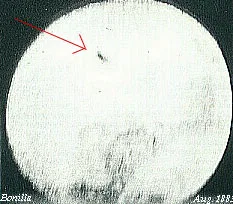
The José A. y Bonilla photograph of 1883 is one of the earliest and most debated astronomical photographs ever linked to unidentified flying objects (UFOs). Taken by Mexican astronomer José A.
Page outline Jump by section
Introduction
The case remains interesting because it combines a credible 19th-century observer, surviving photographic material, a published scientific report, and a continuing disagreement over interpretation. The photographs prove that Bonilla recorded something unusual crossing his field of view; they do not, by themselves, identify what the objects were.[Wikipedia]WikipediaBonilla observationBonilla observation
The 1883 observation at Zacatecas Observatory
José A. y Bonilla (1853–1920) was a Mexican astronomer and engineer who became the first director of the Astronomical Observatory in the state of Zacatecas after it opened in 1882. On 12 August 1883, while preparing observations of the Sun, Bonilla noticed dark objects passing across the solar disc.[Wikipedia]WikipediaBonilla observationBonilla observation
Using wet-plate photographic techniques, a common photographic process of the period, Bonilla attempted to capture the phenomenon. Over roughly two days of observation on 12–13 August, he recorded hundreds of images and reported 447 photographed objects. He also described the forms as appearing indistinct or mist-like, with some showing dark trails.[Wikipedia]WikipediaBonilla observationBonilla observation
The photographs were not originally presented as evidence of spacecraft. Bonilla documented an unexplained astronomical event, and his report avoided claiming a specific cause. His observations were later published in the French astronomy journal L’Astronomie in 1886, bringing the case to wider scientific attention.[Wikipedia]WikipediaBonilla observationBonilla observation
Why the photographs became a UFO landmark
The Bonilla images gained their UFO reputation largely because they are among the earliest surviving photographs of an unexplained object observed in the sky. Modern UFO histories frequently describe them as the first UFO photographs, although this label depends on using “UFO” in its broad sense of an unidentified aerial phenomenon rather than an alien spacecraft.[ALIENRESEARCH 地外文明研究]alienresearch.cn地外文明研究TOP 100 UFO CASEsALIENRESEARCH 地外文明研究TOP 100 UFO CASEs - ALIENRESEARCHJuly 14, 2022…
The unusual feature of the case is not simply that objects appeared in the photographs, but that a trained astronomical observer recorded them during a controlled observation. Bonilla was not reporting a brief visual sighting from the ground; he was using an observatory telescope and photographic equipment. This gives the case more documentary weight than many later UFO reports based only on eyewitness descriptions.[Wikipedia]WikipediaBonilla observationBonilla observation
However, the photographs have important limitations. The surviving images are small and low-detail by modern standards, and they do not show recognisable structures or features that would distinguish spacecraft from natural or atmospheric objects. The central question has therefore always been identification, not whether something was photographed.[Wikimedia Commons]commons.wikimedia.orgFile:Jose Bonilla UFO observation 12 August 1883.jpgWikimedia CommonsFile:Jose Bonilla UFO observation 12 August 1883.jpg - Wikimedia CommonsJune 25, 2026…
The original scientific debate: birds, insects, or something else?
When Bonilla’s report appeared in L’Astronomie, the editor and astronomer Camille Flammarion did not accept a mysterious space-based explanation. The publication suggested that Bonilla may have been observing ordinary objects close to the telescope, such as birds, insects, or dust, which could appear as dark silhouettes against the bright Sun.[Wikipedia]WikipediaBonilla observationBonilla observation
This explanation was based on a common problem in solar photography: objects near the telescope’s entrance aperture can be sharply projected against the Sun even though they are actually in Earth’s atmosphere. A flock of birds flying at a suitable distance, for example, could create multiple dark shapes crossing the solar image.
The atmospheric-object explanation also addresses one of the biggest challenges for a distant astronomical interpretation: other observatories did not report seeing the same phenomenon. If large objects had crossed the Sun on a scale visible across a wide region, astronomers elsewhere might have been expected to notice them.[Monkey and Elf]monkeyandelf.coma massive comet almost annihilated humanity in 1883Monkey and ElfThe 1883 Bonilla Observation: A UNAM Team Calculated a Fragmented Comet Passed Within 8,000 Kilometers of EarthMay 14, 2020…
The comet-fragment hypothesis
A different interpretation emerged more than a century later. In 2011, researchers Héctor Manterola, María Ramos Lara, and Guadalupe Cordero from the National Autonomous University of Mexico proposed that Bonilla had photographed fragments of a comet breaking apart during an extremely close encounter with Earth.[arXiv]arxiv.orgInterpretation of the observations made in 1883 in Zacatecas (Mexico): A fragmented Comet that nearly hits the Earth…
Their hypothesis was based on several details from Bonilla’s report:
- the large number of objects recorded;
- their movement across the Sun over a limited period;
- Bonilla’s descriptions of fuzzy appearances and dark trails;
- the possibility that a fragmented comet could produce many separate pieces travelling together.[arXiv]arxiv.orgInterpretation of the observations made in 1883 in Zacatecas (Mexico): A fragmented Comet that nearly hits the Earth…
The researchers calculated that, if this interpretation were correct, the fragments could have passed extremely close to Earth, with estimates ranging from hundreds to several thousand kilometres above the surface depending on assumptions used. They also estimated possible fragment sizes and a parent comet mass covering a very wide range.[arXiv]arxiv.orgInterpretation of the observations made in 1883 in Zacatecas (Mexico): A fragmented Comet that nearly hits the Earth…
The comet explanation is scientifically interesting because it offers a natural space-based explanation rather than an extraterrestrial one. It also demonstrates how modern astronomy can revisit historical observations using methods unavailable to 19th-century researchers. However, it remains a hypothesis rather than a confirmed identification.[arXiv]arxiv.orgInterpretation of the observations made in 1883 in Zacatecas (Mexico): A fragmented Comet that nearly hits the Earth…

What the evidence does — and does not — show
The strongest evidence in the Bonilla case is that a real astronomer recorded a real photographic event. The surviving material and published account indicate that unusual objects appeared in Bonilla’s telescope view while observing the Sun.[Wikimedia Commons]commons.wikimedia.orgFile:Jose Bonilla UFO observation 12 August 1883.jpgWikimedia CommonsFile:Jose Bonilla UFO observation 12 August 1883.jpg - Wikimedia CommonsJune 25, 2026…
What remains uncertain is the nature of those objects. Three broad possibilities have dominated discussion:
Atmospheric objects: Birds, insects, or debris close to the telescope remain a straightforward explanation and match the concerns raised when the observation was first published.[Wikipedia]WikipediaBonilla observationBonilla observation
A fragmented comet: The 2011 UNAM proposal provides a detailed astronomical model that attempts to explain the number, appearance, and movement of the objects.[arXiv]arxiv.orgInterpretation of the observations made in 1883 in Zacatecas (Mexico): A fragmented Comet that nearly hits the Earth…
An unknown phenomenon: Because the historical data are incomplete and the photographs lack modern detail, some aspects cannot be conclusively resolved.
The evidence does not support the claim that the photographs show alien spacecraft. No physical material, independent sightings confirming artificial objects, or identifiable technological features have been produced. The historical importance of the case lies instead in the unusual combination of early astrophotography, scientific observation, and an unresolved identification problem.[Wikipedia]WikipediaBonilla observationBonilla observation
Why the Bonilla photograph still matters
The 1883 Bonilla observation remains significant because it sits at the boundary between astronomy, photographic history, and UFO culture. It shows how a scientific observation can outlive the original explanation and become re-examined as new ideas emerge.
For historians of astronomy, the case is an example of early photographic observation being used to investigate transient events in the sky. For UFO researchers, it represents one of the earliest recorded unidentified aerial photographs. For sceptical investigators, it illustrates the importance of separating the certainty of an observation from uncertainty about interpretation.
More than 140 years later, the most defensible conclusion is that Bonilla photographed an unusual phenomenon over Zacatecas in 1883, but the exact identity of the objects remains debated. The photographs are authentic historical evidence; the leap from unidentified objects to spacecraft is not supported by the available record.[Wikimedia Commons]commons.wikimedia.orgFile:Jose Bonilla UFO observation 12 August 1883.jpgWikimedia CommonsFile:Jose Bonilla UFO observation 12 August 1883.jpg - Wikimedia CommonsJune 25, 2026…
Amazon book picks
Further Reading
Books and field guides related to What Did Bonilla Photograph Over Zacatecas?. Use these as the next step if you want deeper reading beyond the article.
Cosmos
The best-selling science book ever published in the English language, COSMOS is a magnificent overview of the past, present, and future o...
The UFO Experience: A Scientific Inquiry
Cited by the New York Review of Books as "the best brief for visitation," this classic study presents an analysis of UFO reports and conc...
A History of Astronomy from Thales to Kepler
Masterpiece of historical insight and scientific accuracy and the definitive work on Greek astronomy and the Copernican Revolution. Inclu...
The Demon-Haunted World: Science as a Candle in the Dark
Are we on the brink of a new Dark Age of irrationality and superstition? In this book, the writer shows how scientific thinking is necess...
eBay marketplace picks
Marketplace Samples
Live-tested eBay searches with available results related to this page.
Selected fromastronomy poster oneBay.co.uk.
Endnotes
1.
Source: commons.wikimedia.org
Title: File:Jose Bonilla UFO observation 12 August 1883.jpg
Link:https://commons.wikimedia.org/wiki/File%3AJose_Bonilla_UFO_observation_12_August_1883.jpg
Source snippet
Wikimedia CommonsFile:Jose Bonilla UFO observation 12 August 1883.jpg - Wikimedia CommonsJune 25, 2026...
Published: August 1883
2.
Source: Wikipedia
Title: Bonilla observation
Link:https://en.wikipedia.org/wiki/Bonilla_observation
3.
Source: arxiv.org
Link:https://arxiv.org/abs/1110.2798
Source snippet
Interpretation of the observations made in 1883 in Zacatecas (Mexico): A fragmented Comet that nearly hits the Earth...
4.
Source: Wikipedia
Link:https://en.wikipedia.org/wiki/L%27Astronomie
5.
Source: alienresearch.cn
Title: 地外文明研究TOP 100 UFO CASEs
Link:https://alienresearch.cn/top-100-ufo-cases/
Source snippet
ALIENRESEARCH 地外文明研究TOP 100 UFO CASEs - ALIENRESEARCHJuly 14, 2022...
Published: July 14, 2022
6.
Source: camille-flammarion.fr
Link:https://camille-flammarion.fr/conferences/
7.
Source: camille-flammarion.fr
Title: la vie et loeuvre de camille flammarion
Link:https://camille-flammarion.fr/la-vie-et-loeuvre-de-camille-flammarion/
8.
Source: camille-flammarion.fr
Link:https://camille-flammarion.fr/biographie/
9.
Source: camille-flammarion.fr
Link:https://camille-flammarion.fr/ouvrages/
10.
Source: nature.com
Title: Our Astronomical Column | Nature
Link:https://www.nature.com/articles/036308a0
11.
Source: nature.com
Title: Our Astronomical Column | Nature
Link:https://www.nature.com/articles/035037a0
12.
Source: nature.com
Title: Humming in the Air caused by Insects | Nature
Link:https://www.nature.com/articles/034572b0.pdf
13.
Source: nature.com
Link:https://www.nature.com/nature/volumes/34/issues/885
14.
Source: nature.com
Title: The Zodiacal Light(?) | Nature
Link:https://www.nature.com/articles/027580g0
15.
Source: nature.com
Title: ASTRONOMICA L PHOTOGRAPHY | Nature
Link:https://www.nature.com/articles/027556c0.pdf
16.
Source: monkeyandelf.com
Title: a massive comet almost annihilated humanity in 1883
Link:https://www.monkeyandelf.com/a-massive-comet-almost-annihilated-humanity-in-1883/
Source snippet
Monkey and ElfThe 1883 Bonilla Observation: A UNAM Team Calculated a Fragmented Comet Passed Within 8,000 Kilometers of EarthMay 14, 2020...
Published: May 14, 2020
17.
Source: sis-group.org.uk
Link:https://www.sis-group.org.uk/news/2023/01/12/bonilla/
18.
Source: unconventionalindividualist.wordpress.com
Title: top 100 ufo cases
Link:https://unconventionalindividualist.wordpress.com/2008/01/23/top-100-ufo-cases/
Additional References
19.
Source: zacatecas.gob.mx
Link:https://www.zacatecas.gob.mx/autoridades-estatales-realizan-busqueda-forense-en-inmediaciones-de-mina-el-bote/
Source snippet
February 4, 2026 — AUTORIDADES ESTATALES REALIZAN BÚSQUEDA FORENSE EN INMEDIACIONES DE MINA EL BOTE Autoridades estatales realizan búsque...
Published: February 4, 2026
20.
Source: zacatecas.gob.mx
Link:https://www.zacatecas.gob.mx/narran-historiadores-e-investigadores-la-toma-de-zacatecas-desde-la-fotografia-cinematografia-y-los-comics/
Source snippet
tecasJune 19, 2026 — NARRAN HISTORIADORES E INVESTIGADORES LA TOMA DE ZACATECAS DESDE LA FOTOGRAFÍA, CINEMATOGRAFÍA Y LOS COMICS Narran h...
Published: June 19, 2026
21.
Source: spookyvalley.com
Title: His photographs may be the first images of unident
Link:https://spookyvalley.com/events/1883-jose-bonilla-observation/
Source snippet
José Bonilla UFO Observation | Spooky ValleyJuly 12, 2026 — JOSÉ BONILLA UFO OBSERVATION UFO Mexican astronomer José Bonilla photographed...
Published: July 12, 2026
22.
Source: youtube.com
Title: Top 10 Times the World should have ENDED!! List of crazy world events!
Link:https://www.youtube.com/watch?v=k6JP-ghEn88
Source snippet
Top 10 Mysterious UFO Sightings - Fact or Fiction | Educational Videos by Mocomi Kids...
23.
Source: researchgate.net
Link:https://www.researchgate.net/publication/51945342_Interpretation_of_the_observations_made_in_1883_in_Zacatecas_Mexico_Afragmented_Comet_that_nearly_hits_the_Earth
24.
Source: martinshough.com
Link:https://www.martinshough.com/aerialphenomena/
25.
Source: researchgate.net
Link:https://www.researchgate.net/figure/Geometry-of-Bonillas-observation-Z-Zacatecas-M-Mexico-City-or-Puebla-and-O-is-the_fig1_51945342
26.
Source: en-academic.com
Link:https://en-academic.com/dic.nsf/enwiki/685587
27.
Source: fiscaliazacatecas.gob.mx
Link:https://www.fiscaliazacatecas.gob.mx/la-fiscalia-general-informa-avances-en-el-caso-de-los-cinco-jovenes-desaparecidos-en-la-capital-del-estado/
28.
Source: phys.org
Link:https://phys.org/news/2011-10-mexican-astronomers-bonilla-sighting-comet.html