Within Ubatuba Files
What The Ubatuba Metal Really Revealed
The famous metal fragments were examined for composition, purity, and origin, but their link to a UFO remains unproven.
On this page
- Early claims about the magnesium fragments
- Laboratory tests and changing results
- Why composition does not prove origin
Page outline Jump by section
Introduction
The Ubatuba magnesium fragments became the most famous piece of physical evidence connected with the 1957 Ubatuba incident because early tests appeared to show an almost perfectly pure sample of magnesium. That finding was interpreted by some UFO researchers as evidence of a material unlike anything manufactured on Earth. Later laboratory work produced a more complicated picture: the fragments are magnesium-rich and unusual in some respects, but their composition has not demonstrated an extraterrestrial origin.[NICAP]nicap.orgUbatuba IncidentUbatuba Incident - Condon…
The central scientific question is therefore narrower than whether the Ubatuba event occurred: what exactly were the fragments made of, and do their chemical or isotopic properties require an unknown source? Decades of testing have examined purity, trace elements, crystal structure, and magnesium isotope ratios. The results show why the fragments remain debated: some measurements revealed unusual features, but the strongest proposed indicators of non-terrestrial origin have not been confirmed.[NICAP]nicap.orgUbatuba CaseUbatuba Case - Composition Analysis Of The Brazilian Magnesium…
Early claims about the magnesium fragments
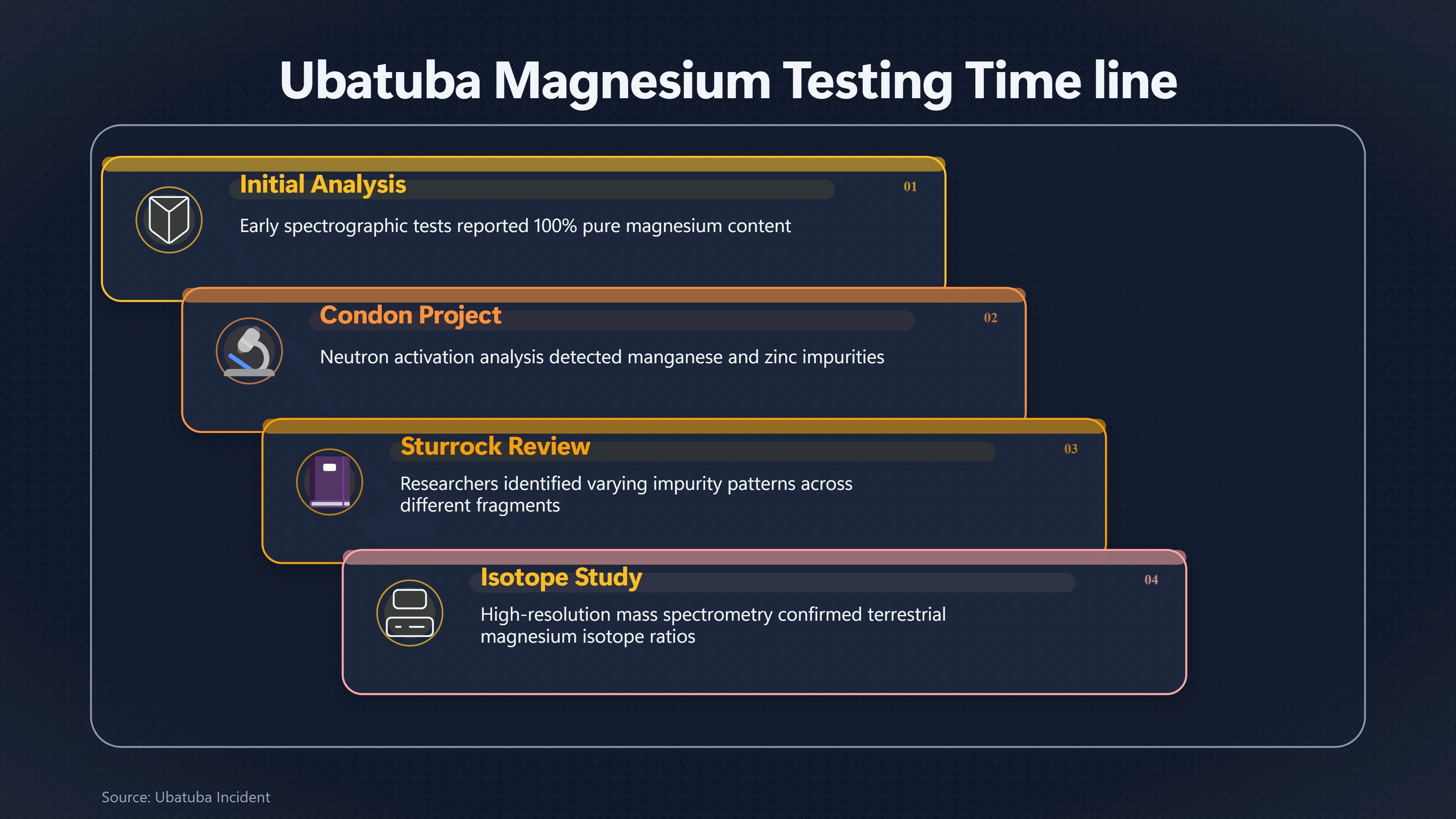
The first major claim about the fragments came from analyses arranged after the material was publicised in Brazil in 1957. Early spectrographic testing reportedly found no detectable impurities, leading to descriptions of the material as “100% magnesium”. However, the limitation of those early tests was sensitivity: the instruments could only detect elements above certain concentrations. Later examinations showed that the absence of detected impurities did not mean the absence of impurities.[ResearchGate]researchgate.netResearchGate(PDF) Isotope Ratios and Chemical Analysis of the 1957 Brazilian Ubatuba Fragment…
The initial appeal of the fragments came from the idea that ordinary industrial magnesium could not match the reported purity. Magnesium is a common terrestrial metal, but extremely high-purity forms were already possible through specialised industrial processes. The later comparison with highly purified magnesium produced by companies such as Dow Chemical became important because it changed the question from “can humans make pure magnesium?” to “is this particular magnesium composition outside known terrestrial production?”[NICAP]nicap.orgUbatuba IncidentUbatuba Incident - Condon…
A second issue was provenance. The laboratory results could describe the metal itself, but they could not independently prove that the samples had fallen from the alleged aerial object. The chain connecting the fragments to the reported explosion remained uncertain because the original witness was not independently verified. This distinction became crucial in later evaluations: an unusual alloy would not automatically establish that it came from a spacecraft.[NICAP]nicap.orgUbatuba IncidentUbatuba Incident - Condon…
Laboratory tests changed the purity story
The Condon Project examination
The most influential official examination was conducted by the University of Colorado’s Scientific Study of Unidentified Flying Objects, commonly called the Condon Report, published in 1969. The project compared a Ubatuba fragment with highly purified magnesium and used neutron activation analysis, a technique capable of detecting very small quantities of elements by measuring radioactive products created after neutron exposure.[NICAP]nicap.orgUbatuba IncidentUbatuba Incident - Condon…
The results challenged the idea that the fragment was chemically pure. The analysis detected several impurities, including manganese, zinc, chromium, copper, barium and strontium. The sample contained hundreds of parts per million of some elements, particularly strontium and barium, meaning it was not cleaner than the best terrestrial magnesium available at the time.[NICAP]nicap.orgUbatuba IncidentUbatuba Incident - Condon…
The Condon analysis also investigated a long-standing claim that the fragment might consist of an unusual magnesium isotope mixture, especially an enrichment of magnesium-26. The testing found that the magnesium isotope content did not differ significantly from other magnesium samples examined by the investigators. This weakened one of the main arguments that the metal had a non-terrestrial signature.[NCAS Files]files.ncas.orgFiles Condon Report Section III, Chapter 3: Direct Physical EvidenceNCAS FilesCondon Report Section III, Chapter 3: Direct Physical Evidence…
The result did not prove how the fragment was produced or where it originated. Instead, it narrowed the possibilities: the material behaved like a terrestrial magnesium sample rather than a substance requiring a new explanation.[NICAP]nicap.orgUbatuba CaseUbatuba Case - Composition Analysis Of The Brazilian Magnesium…
Later chemical studies found a more complex material
Subsequent researchers continued examining surviving pieces because different fragments had produced somewhat different results. Peter Sturrock’s 2001 review of Ubatuba magnesium analyses found that samples shared similarities but also showed differences in impurity patterns, suggesting that the fragments had experienced different influences or histories. Some elements could plausibly have resulted from environmental exposure, while others were harder to explain simply as seawater or sand contamination.[ResearchGate]researchgate.netResearch Gate(PDF) Composition Analysis of the Brazil MagnesiumResearchGate(PDF) Composition Analysis of the Brazil MagnesiumMarch 1, 2001…
These differences created an important complication. The Ubatuba material was not a single large object available for repeated testing; it consisted of small fragments analysed by different laboratories at different times. Because sample sizes were limited, every test consumed or altered a portion of rare material, making direct replication difficult.[ResearchGate]researchgate.netResearchGate(PDF) Isotope Ratios and Chemical Analysis of the 1957 Brazilian Ubatuba Fragment…
Modern isotope testing narrowed the debate
The most recent major investigation focused on isotope ratios rather than only chemical purity. Isotopes are forms of the same element with different atomic masses. For magnesium, researchers can compare the proportions of magnesium-24, magnesium-25 and magnesium-26. An unusual isotope pattern could potentially indicate a non-standard origin or unusual manufacturing process.[Journal of Scientific Exploration]journalofscientificexploration.orgJournal of Scientific ExplorationIsotope Ratios and Chemical Analysis of the 1957 Brazilian Ubatuba Fragment | Journal of Scientific Expl…
A 2022 study examined a Ubatuba fragment using high-resolution inductively coupled plasma mass spectrometry (HR-ICPMS), a highly sensitive method for measuring isotope ratios. The researchers reviewed earlier laboratory work from the 1960s through the 1980s and analysed magnesium and trace elements including strontium, barium, copper and zinc.[ResearchGate]researchgate.netResearchGate(PDF) Isotope Ratios and Chemical Analysis of the 1957 Brazilian Ubatuba Fragment…
The study found that the magnesium isotope ratios fell within terrestrial ranges. The results for trace-element isotope ratios were less conclusive, partly because the tiny sample size and limited remaining material made interpretation difficult. The authors concluded that the analyses did not establish a non-terrestrial origin, while noting that some trace-element questions remained unresolved.[Journal of Scientific Exploration]journalofscientificexploration.orgJournal of Scientific ExplorationIsotope Ratios and Chemical Analysis of the 1957 Brazilian Ubatuba Fragment | Journal of Scientific Expl…
This finding changed the nature of the debate. Earlier arguments focused on whether the metal was “impossible” magnesium. Modern testing instead asks more specific questions: whether unusual trace-element patterns are meaningful, whether contamination affected the samples, and whether the fragments can be reliably linked to the reported event.[ResearchGate]researchgate.netResearchGate(PDF) Isotope Ratios and Chemical Analysis of the 1957 Brazilian Ubatuba Fragment…
Why composition does not prove origin
The Ubatuba fragments demonstrate an important principle in physical evidence investigations: a strange material is not the same as proof of a strange source. Laboratory chemistry can determine what a sample contains, but it cannot by itself establish where the sample came from.
Three separate claims must be distinguished:
- The fragments are magnesium-based: This is well supported by multiple analyses.[ResearchGate]researchgate.netResearchGate(PDF) Isotope Ratios and Chemical Analysis of the 1957 Brazilian Ubatuba Fragment…
- The fragments have unusual chemical features: Some impurity patterns, particularly involving strontium and other trace elements, have attracted continued discussion.[ResearchGate]researchgate.netResearchGate(PDF) Isotope Ratios and Chemical Analysis of the 1957 Brazilian Ubatuba Fragment…
- The fragments came from an extraterrestrial vehicle: This has not been demonstrated by laboratory testing.[NICAP]nicap.orgUbatuba CaseUbatuba Case - Composition Analysis Of The Brazilian Magnesium…
The strongest unresolved issue is not whether magnesium can exist with unusual purity or composition. Terrestrial industry has produced very pure magnesium, and later analyses found the Ubatuba material was not uniquely pure. The harder question is whether the fragments can be reliably connected to the reported 1957 event and whether any remaining anomalies exceed what could occur through terrestrial manufacture, processing, contamination, or environmental exposure.[NICAP]nicap.orgUbatuba CaseUbatuba Case - Composition Analysis Of The Brazilian Magnesium…
The magnesium evidence therefore remains significant historically because it represents one of the rare UFO cases where physical material was subjected to extensive scientific examination. Its lasting importance lies less in proving an extraordinary origin and more in showing how difficult it is to interpret a small, disputed sample without a secure chain of custody and complete contextual information.[Journal of Scientific Exploration]journalofscientificexploration.orgJournal of Scientific ExplorationIsotope Ratios and Chemical Analysis of the 1957 Brazilian Ubatuba Fragment | Journal of Scientific Expl…

Amazon book picks
Further Reading
Books and field guides related to What The Ubatuba Metal Really Revealed. Use these as the next step if you want deeper reading beyond the article.
The Skeptics' Guide to the Universe
An all-encompassing guide to skeptical thinking from podcast host and academic neurologist at Yale University School of Medicine Steven N...
Bad Science
Ben Goldacre takes us on a journey through the bad science we are fed daily by hacks and quacks.
The UFO Experience: A Scientific Inquiry
Cited by the New York Review of Books as "the best brief for visitation," this classic study presents an analysis of UFO reports and conc...
The Demon-Haunted World: Science as a Candle in the Dark
Are we on the brink of a new Dark Age of irrationality and superstition? In this book, the writer shows how scientific thinking is necess...
eBay marketplace picks
Marketplace Samples
Live-tested eBay searches with available results related to this page.
Selected fromscience collectible oneBay.co.uk.

Endnotes
1.
Source: nicap.org
Title: Ubatuba Incident
Link:https://www.nicap.org/reports/ubatubacon.htm
Source snippet
Ubatuba Incident - Condon...
2.
Source: nicap.org
Title: Ubatuba Case
Link:https://www.nicap.org/reports/ubatubanal.htm
Source snippet
Ubatuba Case - Composition Analysis Of The Brazilian Magnesium...
3.
Source: researchgate.net
Link:https://www.researchgate.net/publication/360788800_Isotope_Ratios_and_Chemical_Analysis_of_the_1957_Brazilian_Ubatuba_Fragment
Source snippet
ResearchGate(PDF) Isotope Ratios and Chemical Analysis of the 1957 Brazilian Ubatuba Fragment...
4.
Source: files.ncas.org
Title: Files Condon Report Section III, Chapter 3: Direct Physical Evidence
Link:https://files.ncas.org/condon/text/s3chap03.htm
Source snippet
NCAS FilesCondon Report Section III, Chapter 3: Direct Physical Evidence...
5.
Source: researchgate.net
Title: Research Gate(PDF) Composition Analysis of the Brazil Magnesium
Link:https://www.researchgate.net/publication/237233241_Composition_Analysis_of_the_Brazil_Magnesium
Source snippet
ResearchGate(PDF) Composition Analysis of the Brazil MagnesiumMarch 1, 2001...
Published: March 1, 2001
6.
Source: researchgate.net
Link:https://www.researchgate.net/publication/401344695_Very_High-Temperature_Superconductivity_of_Pure_Mg_Metals_UFOs_and_Cuprates
Source snippet
On Earth, the relative isotopic ratios for Mg24, Mg25 and Mg26 are about 79/10/11 percent. It has often been assumed that if anomalous is...
7.
Source: researchgate.net
Link:https://www.researchgate.net/figure/Plot-of-the-determination-of-the-isotope-ratios-25-Mg-24-Mg-and-26-Mg-24-Mg-From_fig1_360788800
8.
Source: researchgate.net
Link:https://www.researchgate.net/figure/sotopic-composition-as-determined-by-Elemental-Research-Inc-using-high-resolution-mass_fig2_237233241
9.
Source: nicap.org
Link:https://www.nicap.org/reports/uba2.htm
10.
Source: researchgate.net
Title: Bulk Composition Analysis tbl2 237233241
Link:https://www.researchgate.net/figure/Bulk-Composition-Analysis_tbl2_237233241
11.
Source: researchgate.net
Link:https://www.researchgate.net/figure/Early-Composition-Analysis-of-Brazil-Magnesium-Specimens_tbl1_237233241
12.
Source: researchgate.net
Link:https://www.researchgate.net/figure/Mg-isotope-abundance-for-distributions-shown-in-Figure-2_tbl1_360788800
13.
Source: researchgate.net
Link:https://www.researchgate.net/publication/237309319On_Events_Possibly_Related_to_the%27%27Brazil_Magnesium
14.
Source: nature.com
Link:https://www.nature.com/articles/224789b0
15.
Source: journalofscientificexploration.org
Link:https://journalofscientificexploration.org/index.php/jse/article/view/2415
Source snippet
Journal of Scientific ExplorationIsotope Ratios and Chemical Analysis of the 1957 Brazilian Ubatuba Fragment | Journal of Scientific Expl...
16.
Source: explorescu.org
Title: isotope ratios and chemical analysis of the 1957 brazilian ubatuba fragment
Link:https://www.explorescu.org/post/isotope-ratios-and-chemical-analysis-of-the-1957-brazilian-ubatuba-fragment
17.
Source: scribd.com
Title: Isotope Ratios and Chemical Analysis of the 1957 B
Link:https://www.scribd.com/document/718887137/Isotope-Ratios-and-Chemical-Analysis-of-the-1957-B
18.
Source: wikidisc.org
Title: Ubatuba Magnesium Fragments | Wiki Disc
Link:https://www.wikidisc.org/wiki/Ubatuba_Magnesium_Fragments
Additional References
19.
Source: rr0.org
Title: Le docteur Roy F. Craig, un physicie
Link:https://rr0.org/science/crypto/ufo/enquete/dossier/Ubatuba/
Source snippet
Le crash d'UbatubaMay 10, 2025 — FRAGMENT N° 3 POUR CONDON Au milieu des années 1960s, le fragment n° 3 est prêté à l'Université du Color...
Published: May 10, 2025
20.
Source: youtube.com
Title: Professor Garry Nolan & Ross Coulthart: Full interview | UFO UAP News
Link:https://www.youtube.com/watch?v=XR0JtbuLhPo
Source snippet
Garry Nolan - UAP Phenomena: A Serious Look...
21.
Source: ouchaku.github.io
Title: Michael D
Link:https://ouchaku.github.io/ds/blog/2024/08/29/ubatuba_michael_swards_reprt
Source snippet
Swords: UFO が Ubatuba で爆発した際に落下したとされる破片の分析報告書 | UFO/Bigfoot/Missing-411/Supernatural ResearchAugust 29, 2024 — MICHAEL D. SWORDS: UFO が...
Published: August 29, 2024
22.
Source: youtube.com
Title: Garry Nolan
Link:https://www.youtube.com/watch?v=GQr2c3f8Wg8
Source snippet
UFO Crash Debris! (Art's Parts) - Jimmy Akin's Mysterious World...
23.
Source: bjrs.org.br
Link:https://www.bjrs.org.br/revista/index.php/REVISTA/es/article/view/1584
24.
Source: sciencedirect.com
Link:https://www.sciencedirect.com/science/article/pii/S1387380601003803
25.
Source: ufomagazines.com
Link:https://www.ufomagazines.com/bufora-1979-1989-journal-of-transient-aerial-phenomena-jtap-vol-1-no-2-mar-1980/
26.
Source: ufomagazines.com
Link:https://www.ufomagazines.com/apro-bulletin-apro-bulletin-1960-03-00-march/
27.
Source: earth.ox.ac.uk
Link:https://www.earth.ox.ac.uk/publication/276392/scopus
28.
Source: bol.uol.com.br
Link:https://www.bol.uol.com.br/entretenimento/2022/12/28/apos-65-anos-explosao-de-disco-voador-em-praia-de-ubatuba-ainda-e-misterio.htm