Within Tunguska
Why Tunguska Exploded Above the Ground
Tunguska's enormous damage came from a cosmic object exploding in the atmosphere rather than striking the ground directly.
On this page
- How atmospheric explosions work
- Energy released by the incoming object
- Comparisons with other meteor airbursts
Page outline Jump by section
Introduction
The Tunguska event was not a conventional impact in which a space rock carved a crater in the ground. The destruction came from an airburst: a cosmic object entered Earth’s atmosphere at enormous speed, broke apart under aerodynamic pressure, and released most of its energy several kilometres above the Siberian forest. The result was an explosion powerful enough to flatten an estimated 2,000–2,200 square kilometres of taiga while leaving no large impact crater. Modern reconstructions generally place the object as a tens-of-metres-wide asteroid or meteoroid that exploded in the atmosphere with an energy measured in the range of several to around 20 megatons of TNT.[NASA]nasa.gov115 Years Ago: The Tunguska Asteroid Impact Event115 Years Ago: The Tunguska Asteroid Impact Event - NASAJune 30, 2023…
Tunguska remains the classic example of how a relatively small near-Earth object can create regional devastation without reaching the surface. The pattern of forest damage, the absence of a crater, and later comparisons with observed airbursts such as the 2013 Chelyabinsk event all support the explanation that the main destructive force was an atmospheric explosion rather than a ground strike.[NASA]nasa.gov115 Years Ago: The Tunguska Asteroid Impact Event115 Years Ago: The Tunguska Asteroid Impact Event - NASAJune 30, 2023…
How atmospheric explosions work
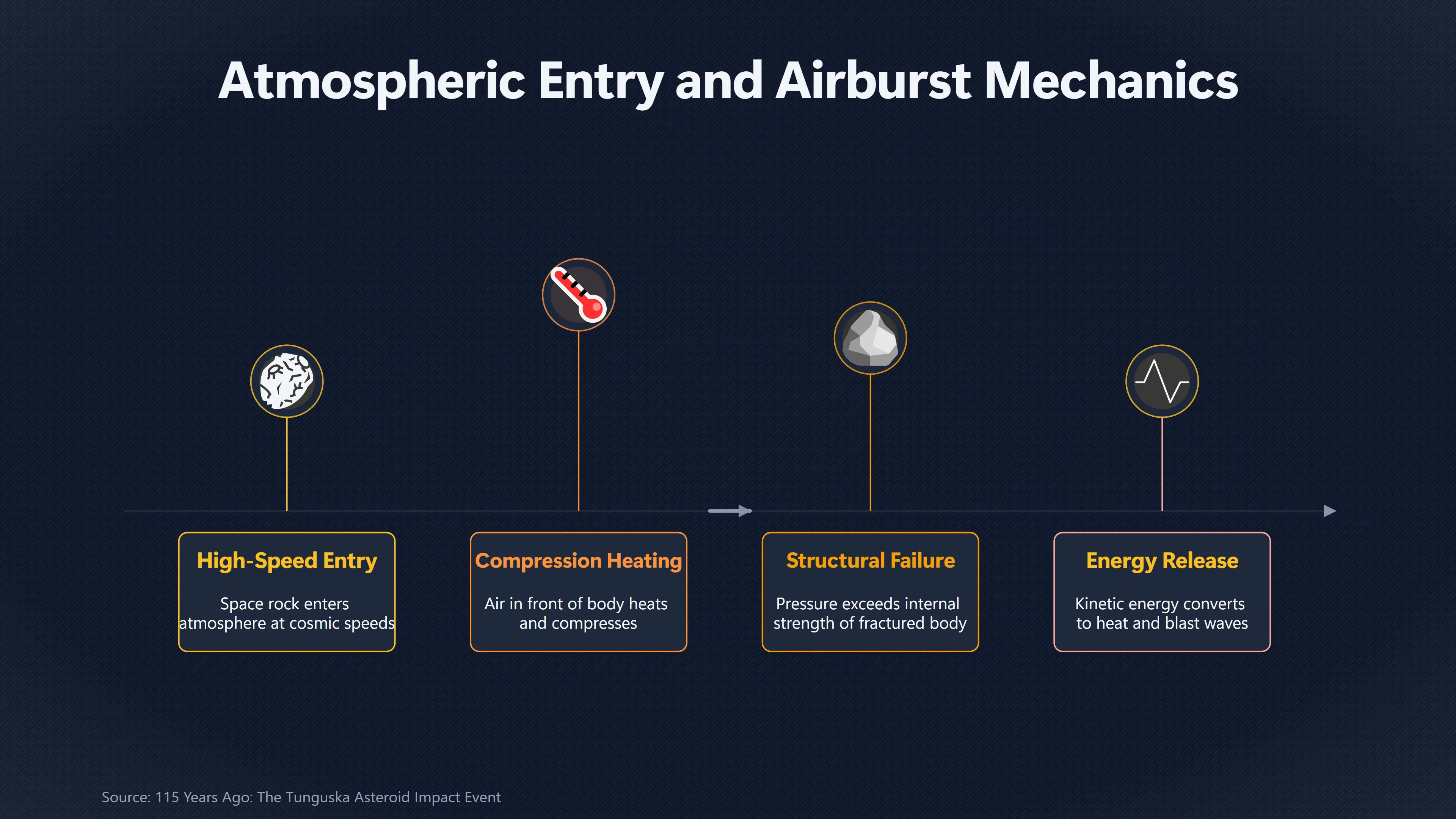
An airburst begins when a fast-moving space object encounters Earth’s atmosphere. At cosmic speeds, the object does not simply fall like an ordinary stone. Air in front of it is compressed and heated, creating a powerful shock wave. At the same time, friction and pressure cause the surface of the object to heat, melt, and vaporise. The atmosphere acts like a brake, rapidly increasing the forces acting on the incoming body.[NASA Technical Reports Server]ntrs.nasa.govNASA Technical Reports ServerNASA/TM—2019–220142April 18, 2026…
For a strong, compact object, some material may survive lower into the atmosphere. However, many asteroids are fractured, porous, or otherwise mechanically weak. When the pressure from the surrounding air exceeds the object’s internal strength, it can fragment suddenly. The energy of the original object’s motion is then deposited into the atmosphere as heat, light, and a rapidly expanding blast wave.[ScienceDirect]sciencedirect.comScienceDirect A computer model of the atmospheric entry of the Tunguska objectA computer model of the atmospheric entry of the Tunguska object - ScienceDirect…
Tunguska’s destruction pattern fits this process. Investigators found that trees had been flattened outward from a central region rather than crushed beneath a single impact point. Close to the centre, some trees remained standing but were stripped of branches and damaged by the intense energy released above them. This unusual combination — a large flattened area with no normal crater — is one of the strongest indicators of an explosion in the air.[NASA]nasa.gov115 Years Ago: The Tunguska Asteroid Impact Event115 Years Ago: The Tunguska Asteroid Impact Event - NASAJune 30, 2023…
Why no crater was formed
The missing crater is often described as Tunguska’s great mystery, but for an airburst it is expected. A crater forms when a large amount of energy is delivered directly into the ground by a surviving object. At Tunguska, most of the object’s energy was released before it reached the surface.
The altitude of the explosion is estimated to have been roughly several kilometres above the ground, with modern studies and NASA workshop analyses commonly converging on an airburst height around 10 kilometres for the most likely scenarios. The exact altitude remains uncertain because researchers must reconstruct a 1908 event from forest patterns, eyewitness reports, and physical modelling rather than direct measurements.[NASA Technical Reports Server]ntrs.nasa.govNASA Technical Reports ServerTunguska Workshop: Applying Modern Tools to Understand the 1908 Tunguska Impact - NASA Technical Reports Ser…
The object’s breakup also explains why researchers found no large meteorite mass comparable to the scale of destruction. Much of the material would have been melted, vaporised, or dispersed through the atmosphere. Some models continue to examine whether small fragments could have survived, but the dominant explanation does not require a surviving large impactor.[arXiv]arxiv.orgarXiv Computation of a possible Tunguska's strewn fieldComputation of a possible Tunguska's strewn fieldFebruary 27, 2023…

Energy released by the incoming object
The Tunguska explosion was enormous by human standards but still within the range expected from a relatively small asteroid. Current estimates commonly place the object at roughly 50–80 metres across if it was a stony asteroid, with an explosion energy around 10–20 megatons of TNT in many modern reconstructions.[NASA Technical Reports Server]ntrs.nasa.govNASA Technical Reports ServerTunguska Workshop: Applying Modern Tools to Understand the 1908 Tunguska Impact - NASA Technical Reports Ser…
The destructive power came from the object’s speed as much as its size. A space rock entering the atmosphere at many kilometres per second carries immense kinetic energy. When that energy is released almost instantly through fragmentation and atmospheric shock, the result resembles a massive explosion despite the absence of conventional explosives or a crater.[NASA Technical Reports Server]ntrs.nasa.govNASA Technical Reports ServerNASA/TM—2019–220142April 18, 2026…
The blast affected the landscape in several ways:
- Shock waves flattened forests: The expanding pressure wave pushed down millions of trees over a huge region. NASA summaries of the event describe roughly 80 million trees being affected across the devastated area.[NASA]nasa.gov115 Years Ago: The Tunguska Asteroid Impact Event115 Years Ago: The Tunguska Asteroid Impact Event - NASAJune 30, 2023…
- Thermal radiation caused burns and fires: Witnesses reported intense heat and bright flashes, consistent with a high-temperature fireball produced by the atmospheric explosion.[NASA Technical Reports Server]ntrs.nasa.govNASA Technical Reports ServerNASA/Technical Memorandum (NASA/TM–220174) 2018March 12, 2026…
- Atmospheric effects travelled far beyond the blast zone: Pressure waves were detected at great distances, showing that the event was not simply a local forest disturbance but a major atmospheric explosion.[NASA Technical Reports Server]ntrs.nasa.govNASA Technical Reports ServerNASA/Technical Memorandum (NASA/TM–220174) 2018March 12, 2026…
The remote location of the explosion greatly reduced the human toll. A similar event over a densely populated area would have produced far greater casualties, because the same blast mechanisms that toppled trees could damage buildings and injure people over a wide region. The 2013 Chelyabinsk event later demonstrated this difference: a much smaller airburst still caused widespread damage and injuries because it occurred over a populated area.[NASA]nasa.govand International Researchers Obtain Crucial Data from Meteoroid ImpactNASA and International Researchers Obtain Crucial Data from Meteoroid Impact - NASA…
Comparisons with other meteor airbursts
The best modern comparison for Tunguska is the Chelyabinsk meteor of 2013. That event involved a much smaller object, estimated at roughly 20 metres across, which exploded in the atmosphere over Russia with an energy of hundreds of kilotons of TNT. Unlike Tunguska, Chelyabinsk was recorded by numerous cameras and scientific instruments, providing detailed evidence of how airbursts behave.[NASA]nasa.gov115 Years Ago: The Tunguska Asteroid Impact Event115 Years Ago: The Tunguska Asteroid Impact Event - NASAJune 30, 2023…
The two events revealed the same basic sequence:
- A near-Earth object entered the atmosphere at high speed.
- Atmospheric pressure and heating caused intense fragmentation.
- The object released most of its energy before reaching the ground.
- The resulting shock wave caused the main damage.
The difference was scale. Tunguska was roughly an order of magnitude more energetic than Chelyabinsk according to NASA summaries, and it occurred over a sparsely populated Siberian forest rather than a major urban area.[NASA]nasa.govThe History of Near-Earth Objects ResearchThe History of Near-Earth Objects ResearchJanuary 19, 2023…
Chelyabinsk also helped improve scientific confidence in Tunguska modelling. Modern computer simulations can now reproduce airburst behaviour by testing variables such as object strength, density, trajectory, and breakup process. Researchers have applied these methods back to Tunguska, refining estimates of the object’s size and the altitude at which it released its energy.[ScienceDirect]sciencedirect.comScienceDirect A computer model of the atmospheric entry of the Tunguska objectA computer model of the atmospheric entry of the Tunguska object - ScienceDirect…
What Tunguska revealed about asteroid hazards
Tunguska changed the understanding of impact risk because it demonstrated that objects far smaller than planet-killing asteroids can still cause major regional disasters. A body only tens of metres across can avoid detection, enter the atmosphere, and produce an explosion comparable to a large conventional weapon.
The event also showed why looking only for craters is misleading. Atmospheric explosions can be among the most destructive cosmic events affecting Earth while leaving little obvious physical evidence at the surface. The flattened forest at Tunguska became, in effect, the crater: a record of where and how the energy was delivered.
More than a century later, Tunguska remains a key case for planetary defence research because it connects historical evidence with modern impact modelling. Its lesson is not that every small asteroid is catastrophic, but that the atmosphere itself can become the location where a cosmic object releases its destructive energy.[NASA Technical Reports Server]ntrs.nasa.govNASA Technical Reports ServerTunguska Workshop: Applying Modern Tools to Understand the 1908 Tunguska Impact - NASA Technical Reports Ser…
Amazon book picks
Further Reading
Books and field guides related to Why Tunguska Exploded Above the Ground. Use these as the next step if you want deeper reading beyond the article.
The Cosmic Perspective
This product contains only the bound textbook and does not include any supplements or media. Building on a long tradition of effective pe...
Astrophysics for People in a Hurry
Rating: 4.5/5 from 7 Google Books ratings
Over a year on the New York Times bestseller list and more than a million copies sold. The essential universe, from our most celebrated a...
The Universe in a Nutshell
Rating: 1.5/5 from 5 Google Books ratings
Stephen Hawking’s phenomenal, multimillion-copy bestseller, A Brief History of Time, introduced the ideas of this brilliant theoretical p...
A Brief History of Time
Rating: 4.0/5 from 7 Google Books ratings
#1 NEW YORK TIMES BESTSELLER A landmark volume in science writing by one of the great minds of our time, Stephen Hawking’s book explores...
eBay marketplace picks
Marketplace Samples
Live-tested eBay searches with available results related to this page.
Selected fromasteroid model oneBay.co.uk.

Endnotes
1.
Source: nasa.gov
Title: 115 Years Ago: The Tunguska Asteroid Impact Event
Link:https://www.nasa.gov/history/115-years-ago-the-tunguska-asteroid-impact-event/
Source snippet
115 Years Ago: The Tunguska Asteroid Impact Event - NASAJune 30, 2023...
Published: June 30, 2023
2.
Source: ntrs.nasa.gov
Link:https://ntrs.nasa.gov/citations/20190002302
Source snippet
NASA Technical Reports ServerTunguska Workshop: Applying Modern Tools to Understand the 1908 Tunguska Impact - NASA Technical Reports Ser...
3.
Source: nasa.gov
Title: and International Researchers Obtain Crucial Data from Meteoroid Impact
Link:https://www.nasa.gov/news-release/nasa-and-international-researchers-obtain-crucial-data-from-meteoroid-impact/
Source snippet
NASA and International Researchers Obtain Crucial Data from Meteoroid Impact - NASA...
4.
Source: ntrs.nasa.gov
Link:https://ntrs.nasa.gov/api/citations/20200000049/downloads/20200000049.pdf
Source snippet
NASA Technical Reports ServerNASA/TM—2019–220142April 18, 2026...
Published: April 18, 2026
5.
Source: sciencedirect.com
Title: ScienceDirect A computer model of the atmospheric entry of the Tunguska object
Link:https://www.sciencedirect.com/science/article/pii/S0032063397000147
Source snippet
A computer model of the atmospheric entry of the Tunguska object - ScienceDirect...
6.
Source: arxiv.org
Title: arXiv Computation of a possible Tunguska’s strewn field
Link:https://arxiv.org/abs/2302.13620
Source snippet
Computation of a possible Tunguska's strewn fieldFebruary 27, 2023...
Published: February 27, 2023
7.
Source: ntrs.nasa.gov
Link:https://ntrs.nasa.gov/api/citations/20190002302/downloads/20190002302.pdf
Source snippet
NASA Technical Reports ServerNASA/Technical Memorandum (NASA/TM--220174) 2018March 12, 2026...
Published: March 12, 2026
8.
Source: nasa.gov
Title: The History of Near-Earth Objects Research
Link:https://www.nasa.gov/wp-content/uploads/2025/07/a-history-of-near-earth-object-research-sp-4235.pdf
Source snippet
The History of Near-Earth Objects ResearchJanuary 19, 2023...
Published: January 19, 2023
9.
Source: nas.nasa.gov
Title: Advanced Supercomputing NASA Researchers Rock the World of Asteroid Simulation
Link:https://www.nas.nasa.gov/pubs/stories/2017/feature_asteroid_simulations.html
Source snippet
A Advanced SupercomputingNASA Researchers Rock the World of Asteroid Simulation...
10.
Source: science.nasa.gov
Title: a cosmic explosion over siberia 154488
Link:https://science.nasa.gov/earth/earth-observatory/a-cosmic-explosion-over-siberia-154488/
11.
Source: sciencedirect.com
Title: A model for thermal radiation from the Tunguska airburst
Link:https://www.sciencedirect.com/science/article/pii/S0019103518304950
12.
Source: sciencedirect.com
Title: Hydrocode simulations of asteroid airbursts and constraints for Tunguska
Link:https://www.sciencedirect.com/science/article/pii/S0019103518304202
13.
Source: nasa.gov
Link:https://www.nasa.gov/solar-system/tunguska-revisited-111-year-old-mystery-impact-inspires-new-more-optimistic-asteroid-predictions/
14.
Source: ntrs.nasa.gov
Link:https://ntrs.nasa.gov/archive/nasa/casi.ntrs.nasa.gov/20190002844.pdf
15.
Source: nas.nasa.gov
Title: feature asteroid impact atap
Link:https://www.nas.nasa.gov/pubs/stories/2018/feature_asteroid_impact_atap.html
16.
Source: ntrs.nasa.gov
Link:https://ntrs.nasa.gov/citations/20140006556
17.
Source: science.nasa.gov
Title: tracking the chelyabinsk meteor plume 81844
Link:https://science.nasa.gov/earth/earth-observatory/tracking-the-chelyabinsk-meteor-plume-81844/
18.
Source: nasa.gov
Title: Around the World in Four Days: NASA Tracks Chelyabinsk Meteor Plume
Link:https://www.nasa.gov/solar-system/around-the-world-in-four-days-nasa-tracks-chelyabinsk-meteor-plume/
19.
Source: ntrs.nasa.gov
Link:https://ntrs.nasa.gov/citations/19830065169
20.
Source: ntrs.nasa.gov
Link:https://ntrs.nasa.gov/citations/19820056827
21.
Source: ntrs.nasa.gov
Link:https://ntrs.nasa.gov/citations/19780067902
22.
Source: sciencedirect.com
Title: Complex modelling of the Tunguska catastrophe
Link:https://www.sciencedirect.com/science/article/abs/pii/S0032063397000834
23.
Source: sciencedirect.com
Link:https://www.sciencedirect.com/science/article/abs/pii/0019103582900963
24.
Source: youtube.com
Link:https://www.youtube.com/watch?v=GzyP5mIwa5M
Source snippet
The Tunguska Event | A Short Documentary | Fascinating Horror...
25.
Source: youtube.com
Title: The Tunguska Event | A Short Documentary | Fascinating Horror
Link:https://www.youtube.com/watch?v=nnhkcqeGtSI
Source snippet
Did an Asteroid Hit Siberia? The Truth About Tunguska...
26.
Source: aps.org
Title: tunguska event
Link:https://www.aps.org/apsnews/2018/06/tunguska-event
Additional References
27.
Source: synapsesocial.com
Link:https://synapsesocial.com/papers/69be37866e48c4981c6772ed
Source snippet
툰구스카 1908: 연쇄 파편화 공중폭발 모델March 21, 2026 — 툰구스카 1908: 연쇄 파편화 공중폭발 모델 | Synapse March 21, 2026 Open Access TUNGUSKA 1908: A CASCADING FRAGM...
Published: March 21, 2026
28.
Source: youtube.com
Title: The Event of Tunguska | Asteroid Day Series
Link:https://www.youtube.com/watch?v=l3nlm5WKUzA
Source snippet
Tunguska event airburst destruction explosion mechanism The Tunguska Asteroid Impact Edgy Stories...
29.
Source: sandia.gov
Link:https://www.sandia.gov/research/publications/details/low-altitude-airbursts-and-the-impact-threat-final-ldrd-report-2007-12-01/
30.
Source: sandia.gov
Link:https://www.sandia.gov/research/publications/details/the-nature-of-airbursts-and-their-contribution-to-the-impact-threat-2010-11-01/
31.
Source: youtube.com
Title: Tunguska Blast Simulation by Sandia Lab
Link:https://www.youtube.com/watch?v=0yY34uWty_0
Source snippet
The Tunguska Blast of 1908: The Century's Greatest Mystery, Solved...
32.
Source: doi.org
Link:https://doi.org/10.1126/SCIENCE.1242642
33.
Source: doi.org
Link:https://doi.org/10.14293/ACI.2024.0004
34.
Source: scienceopen.com
Link:https://www.scienceopen.com/hosted-document?doi=10.14293%2FACI.2024.0004
35.
Source: youtube.com
Title: Did an Asteroid Hit Siberia? The Truth About Tunguska
Link:https://www.youtube.com/watch?v=0hp875r2MbQ
Source snippet
The Event of Tunguska | Asteroid Day Series...
36.
Source: researchgate.net
Title: (PDF) Hydrocode Simulations of Asteroid Airbursts and Constraints for Tunguska
Link:https://www.researchgate.net/publication/328414457_Hydrocode_Simulations_of_Asteroid_Airbursts_and_Constraints_for_Tunguska