Within Mantell Incident
Why Mantell's Interception Ended in Disaster
The interception became fatal when Mantell continued climbing without usable oxygen and lost control of his Mustang.
On this page
- From Routine Flight to Interception
- The Climb Beyond Safe Limits
- Crash Reconstruction and Official Findings
Page outline Jump by section
Introduction
Captain Thomas F. Mantell’s final flight on 7 January 1948 became one of the most discussed episodes in early UFO history not because the unidentified object was ever conclusively explained, but because the interception ended in a fatal high-altitude climb. After being directed to investigate a distant object seen from Godman Field in Kentucky, Mantell continued ascending in his F-51D Mustang after his accompanying pilots broke off. The evidence assembled by the subsequent accident investigation strongly indicates that he climbed beyond the safe operating altitude for an aircraft lacking usable oxygen equipment, lost consciousness from oxygen deprivation (anoxia or hypoxia), and never recovered control. His aircraft entered an uncontrolled descent, exceeded its structural limits and disintegrated before crashing near Franklin, Kentucky.[NICAP]nicap.orgMantell An AnatomyMantell An Anatomy - Complete Report…

The fatal sequence has remained central to the Thomas F. Mantell incident because it illustrates how an ordinary interception mission evolved into a deadly accident through a combination of operational decisions, human physiology and uncertainty about the object being pursued. While debate over the object’s identity belongs to the broader case, the mechanics of Mantell’s final climb are considerably better documented than many later retellings suggest.
From Routine Flight to Interception
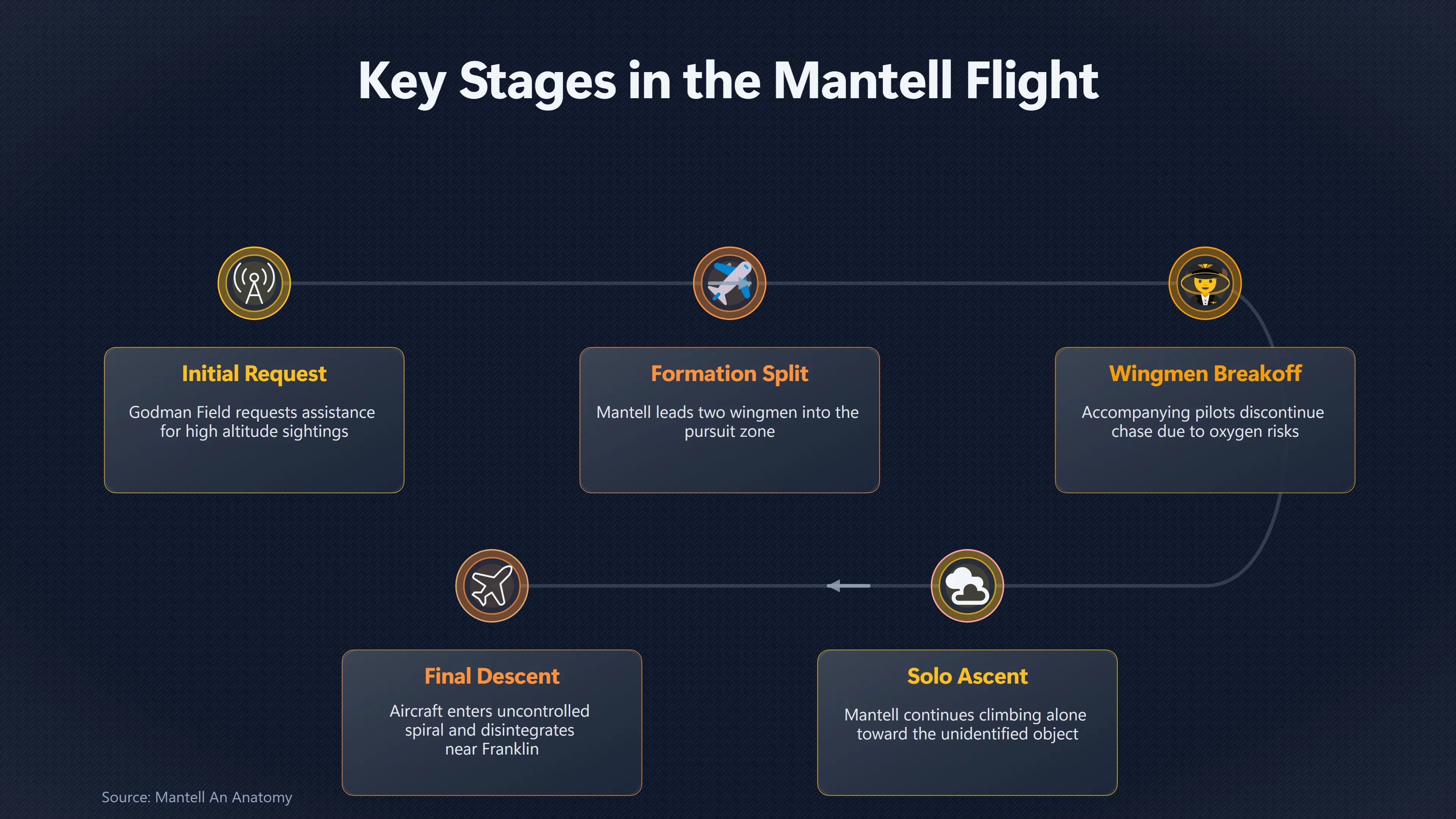
Mantell was not flying a dedicated interception mission when events unfolded. He was leading four Kentucky Air National Guard F-51D Mustangs returning from Marietta, Georgia, to Louisville. As the formation approached Kentucky, personnel at Godman Field requested assistance after military observers and numerous civilians had reported a bright object high in the afternoon sky. Mantell acknowledged the request and altered course with two wingmen, while another aircraft continued towards its planned destination.[NICAP]nicap.orgIncident StatementsIncident Statements - Mantell Case…
The pursuit developed gradually rather than as a high-speed scramble. The unidentified object appeared well above the fighters, requiring a prolonged climb instead of a rapid intercept. Surviving witness statements reconstructed after the accident describe Mantell reporting that the object remained ahead and above his aircraft while he attempted to gain altitude. Although later books often present his famous descriptions as exact quotations, investigators found no verbatim radio recording. The widely quoted remarks about a “metallic” object of “tremendous size” derive from witness recollections rather than an official transcript, and different listeners remembered slightly different wording.[NICAP]nicap.orgairforcedocAugust 21, 1952…
This distinction matters because it separates two different historical questions:
- The pursuit itself is firmly documented through multiple military statements.
- The precise wording of Mantell’s final observations is reconstructed testimony rather than recorded audio.
The Climb Beyond Safe Limits
The decisive turning point came as altitude increased.
Mantell’s accompanying pilots recognised that continuing the climb posed increasing risk. Contemporary reports indicate that the formation lacked adequate oxygen capability for sustained operation at very high altitude. One pilot who possessed functioning oxygen equipment continued longer than the others, but eventually the formation separated as concerns about oxygen supply and aircraft performance increased. Mantell, however, pressed on alone.[NICAP]nicap.orgMantell An AnatomyMantell An Anatomy - Complete Report…
Investigators concluded that this decision fundamentally changed the nature of the mission. Above roughly 20,000 feet, oxygen deprivation can rapidly impair judgement, vision and motor control. As altitude increases further, the useful period during which a pilot remains capable of making rational decisions becomes progressively shorter without supplemental oxygen.
Several features of the accident fit that physiological progression:
- Mantell continued climbing after his companions discontinued the chase.
- Radio communication ceased without any distress call.
- No evidence suggested evasive manoeuvres or an intentional dive.
- The aircraft continued climbing after the pilot likely became incapacitated because it had already been trimmed for maximum climb.[NICAP]nicap.orgMantell An AnatomyMantell An Anatomy - Complete Report…
The official accident board estimated that Mantell became unconscious at approximately 25,000 feet. Because the aircraft remained configured for climb under full power, investigators believed it continued ascending to roughly 30,000 feet before naturally slowing, levelling and entering an uncontrolled spiral descent.[NICAP]nicap.orgMantell An AnatomyMantell An Anatomy - Complete Report…
This sequence explains why no further radio transmissions were received. Rather than a sudden mechanical catastrophe during the climb, the evidence points to gradual pilot incapacitation followed by an aircraft that continued flying without effective human control.

Why the Aircraft Could Not Recover
An unmanned F-51 Mustang does not simply continue in stable flight indefinitely.
Once Mantell became unconscious, several aerodynamic effects combined:
- The engine continued producing high power.
- The aircraft’s climb eventually stalled as available lift decreased.
- The aircraft entered a descending spiral.
- Increasing airspeed during the dive generated aerodynamic loads beyond the Mustang’s structural design limits.
The accident board concluded that these excessive loads caused the aircraft to begin breaking apart before impact. Witnesses on the ground reported seeing the aircraft descending in a spiral and then disintegrating during the final stages of its fall. Investigators also noted that the canopy locking mechanism remained secured, indicating that Mantell never attempted to bail out—further supporting the conclusion that he was already unconscious before the terminal dive began.[NICAP]nicap.orgMantell An AnatomyMantell An Anatomy - Complete Report…
Rather than indicating an explosion or external attack, the structural breakup was consistent with overspeed during an uncontrolled high-power dive.
Crash Reconstruction and Official Findings
The wreckage fell near Franklin, Kentucky, during the afternoon of 7 January 1948. Mantell died on impact, and his F-51D was destroyed.
The Air Force accident investigation focused primarily on reconstructing the aircraft’s final moments rather than identifying the object itself. Its principal findings were comparatively straightforward:
- no evidence supported an in-flight collision;
- no evidence indicated enemy action or weapons damage;
- the engine appeared to have been operating normally during the descent;
- pilot incapacitation from oxygen deprivation best explained the loss of control;
- the subsequent dive caused the aircraft to exceed its structural limits.[NICAP]nicap.orgMantell An AnatomyMantell An Anatomy - Complete Report…
One point has generated continuing discussion among later researchers: contemporary documentation contains inconsistencies regarding the exact condition and availability of Mantell’s oxygen equipment. Some portions of the documentation refer to the aircraft’s oxygen system as serviceable, while later sections criticise the decision to climb “without oxygen equipment”. Modern researchers generally interpret this as reflecting uncertainty over whether usable oxygen was available or effectively employed during the climb rather than evidence against hypoxia itself. Regardless of that documentary inconsistency, the investigation consistently attributed the fatal loss of control to oxygen deprivation rather than mechanical failure.[NICAP]nicap.orgMantell An AnatomyMantell An Anatomy - Complete Report…
What the Final Flight Demonstrates
Within the broader Thomas F. Mantell incident, the fatal climb stands apart because its central mechanism is supported by considerably stronger evidence than the identity of the object being pursued.
The available evidence supports several conclusions with relatively high confidence:
- Mantell deliberately continued climbing after other pilots discontinued the interception.
- He reached an altitude incompatible with prolonged safe flight without effective supplemental oxygen.
- His radio transmissions ceased abruptly without any emergency call.
- His aircraft entered an uncontrolled descent while still under power.
- Structural failure occurred during the high-speed dive, not before it.
By contrast, the object that prompted the pursuit remains a separate historical question. Early Air Force investigators proposed Venus, while later reviews considered a classified Skyhook research balloon the more plausible explanation. Those competing interpretations affect why Mantell climbed, but they do not substantially alter the accident sequence itself. The physical evidence from the crash consistently indicates that the immediate cause of the disaster was loss of consciousness during an excessive high-altitude climb rather than any direct interaction with the unidentified object.[NICAP]nicap.orgMantell An AnatomyMantell An Anatomy - Complete Report…
Amazon book picks
Further Reading
Books and field guides related to Why Mantell's Interception Ended in Disaster. Use these as the next step if you want deeper reading beyond the article.
The Right Stuff
Rating: 4.5/5 from 8 Google Books ratings
The first Americans in space--Yeager, Conrad, Grissom, and Glenn--battle the Russians for control of the heavens and put their lives on t...
The UFO Experience: A Scientific Inquiry
Cited by the New York Review of Books as "the best brief for visitation," this classic study presents an analysis of UFO reports and conc...
The Report on Unidentified Flying Objects
The Report on Unidentified Flying Objects, written by Captain Edward Ruppelt in 1956, was the first serious, unbiased account written abo...
The Demon-haunted World
Rating: 4.5/5 from 43 Google Books ratings
Are we on the brink of a new Dark Age of irrationality and superstition? In this book, the writer shows how scientific thinking is necess...
eBay marketplace picks
Marketplace Samples
Live-tested eBay searches with available results related to this page.
Selected fromaviation poster oneBay.co.uk.




Endnotes
1.
Source: nicap.org
Title: Mantell An Anatomy
Link:https://www.nicap.org/mantellcomp.htm
Source snippet
Mantell An Anatomy - Complete Report...
2.
Source: nicap.org
Title: Incident Statements
Link:https://www.nicap.org/docs/mantell/Mantell_Incident_Statements.htm
Source snippet
Incident Statements - Mantell Case...
3.
Source: nicap.org
Link:https://www.nicap.org/docs/mantell/mantell_ins1952.htm
Source snippet
airforcedocAugust 21, 1952...
Published: August 21, 1952
4.
Source: nicap.org
Title: Either Way Man Dies In Pursuit WFIE Interview, Mantell Cas
Link:https://www.nicap.org/docs/mantell/mantell480107_WFIE_part2.htm
Source snippet
mantell wfie part 2July 27, 2006 — Reference 2 Form: 97, Media Coverage Date: Thu, 27 Jul 2006 07:25:27 -0500 From: Francis Ridge <nicap@...
Published: July 27, 2006
5.
Source: nicap.org
Title: ky ohio cases480107dir
Link:https://www.nicap.org/docs/mantell/ky_ohio_cases480107dir.htm
6.
Source: nicap.org
Link:https://www.nicap.org/mantelldir.htm
7.
Source: nicap.org
Title: loedd conclusion
Link:https://nicap.org/docs/loedd/loedd_conclusion.htm
8.
Source: nicap.org
Title: Part 3
Link:https://www.nicap.org/mantell/mantell_part_3_2.htm
9.
Source: nicap.org
Title: The Mantell Incident
Link:https://www.nicap.org/docs/mantell/mantell2.htm
Additional References
10.
Source: thinkaboutitdocs.com
Title: the thomas mantell incident aircraft crashes after chasing ufo
Link:https://thinkaboutitdocs.com/the-thomas-mantell-incident-aircraft-crashes-after-chasing-ufo/
Source snippet
PICKERING VHF/DF Operator CAF 7 * * * Below is typed transcription of document. UNCLASSIFIED MCIA/ACL/amb JAN 14, 1947 Request for Report...
12.
Source: everand.com
Title: The CIA UFO Papers by Dan Wright (Ebook)
Link:https://www.everand.com/book/654867033/The-CIA-UFO-Papers-50-Years-of-Government-Secrets-and-Cover-Ups
Source snippet
Read free for 30 daysSeptember 1, 2019 — MANTELL INCIDENT On the afternoon of January 7, 1948, Kentucky Air National Guard's Thomas Mante...
Published: September 1, 2019
13.
Source: youtube.com
Title: The Thomas Mantell Case
Link:https://www.youtube.com/watch?v=3zW1thRS3T8
Source snippet
Mantell UFO Incident 1948 flight climb crash The Mantell UFO Incident (1948) | Pilot Dies Chasing Mysterious Object Over Kentucky FringeA...
14.
Source: youtube.com
Title: Skilled WWII Pilot Reports Chasing Unidentified Object and Mysteriously Dies
Link:https://www.youtube.com/watch?v=tNMe2Gfniqg
Source snippet
Chasing The Unknown | 1948 Mantell UFO Incident...
15.
Source: strangestrangestrange.com
Title: When UFO Attacks
Link:https://strangestrangestrange.com/paranormal/ufo/thomas-mantell-ufo-incident/
Source snippet
Hammond reached 15,000 feet. Some of the documentation suggests that all three aircraft reached 22,000 feet. Then the two wingmen turned...
16.
Source: science.howstuffworks.com
Title: ufo government3
Link:https://science.howstuffworks.com/space/aliens-ufos/ufo-government3.htm
Source snippet
Mantell, Jr., died when his F-51 crashed after chasing what he called, in one of his last radio transmissions, "a metallic object of trem...
17.
Source: youtube.com
Link:https://www.youtube.com/watch?v=XKNW0UTDUFE
Source snippet
UFO OR FAILURE? | The Captain Thomas F. Mantell Crash...
18.
Source: youtube.com
Link:https://www.youtube.com/watch?v=pPQtKT5NtR8
Source snippet
The Horrifying True Story of the 1948 Mantell UFO Plane Crash...
19.
Source: theufodatabase.com
Link:https://theufodatabase.com/docs/mantell-incident-1948-01-09-the-baltimore-sun