Within Apollo 11 Sightings
Why Apollo Astronauts Saw Strange Light Flashes
Apollo 11 astronauts observed flashes of light that were later linked to cosmic rays affecting human vision rather than external objects.
On this page
- Reports of flashes during deep space travel
- Cosmic ray explanations and research
- Separating visual effects from sightings
Page outline Jump by section
Introduction
The Apollo 11 “space flash” phenomenon was a genuine observation by astronauts, but it was not evidence of external objects near the spacecraft. During the first crewed mission to the Moon in 1969, astronauts reported seeing brief flashes of light while travelling beyond Earth’s protective magnetic environment. Later research showed that these flashes were most likely caused by high-energy cosmic radiation interacting with the astronauts’ eyes or visual system, creating the sensation of seeing light even when no visible light source was present.[Nature]nature.comGeneration of Cherenkov Light Flashes by Cosmic Radiation within the Eyes of the Apollo Astronauts | NatureOctober 17, 1970…
The importance of the phenomenon is that it represents one of the earliest documented examples of humans experiencing a new type of space environment effect. The Apollo 11 observations became the starting point for a wider investigation across later Apollo missions, eventually producing physiological experiments, particle-physics studies and a scientific explanation for why astronauts could “see” radiation passing through their bodies.[NASA Technical Reports Server]ntrs.nasa.govTechnical Reports Server Light flash phenomenon seen by astronautsNASA Technical Reports ServerLight flash phenomenon seen by astronauts - NASA Technical Reports Server (NTRS)…
Reports of flashes during deep space travel
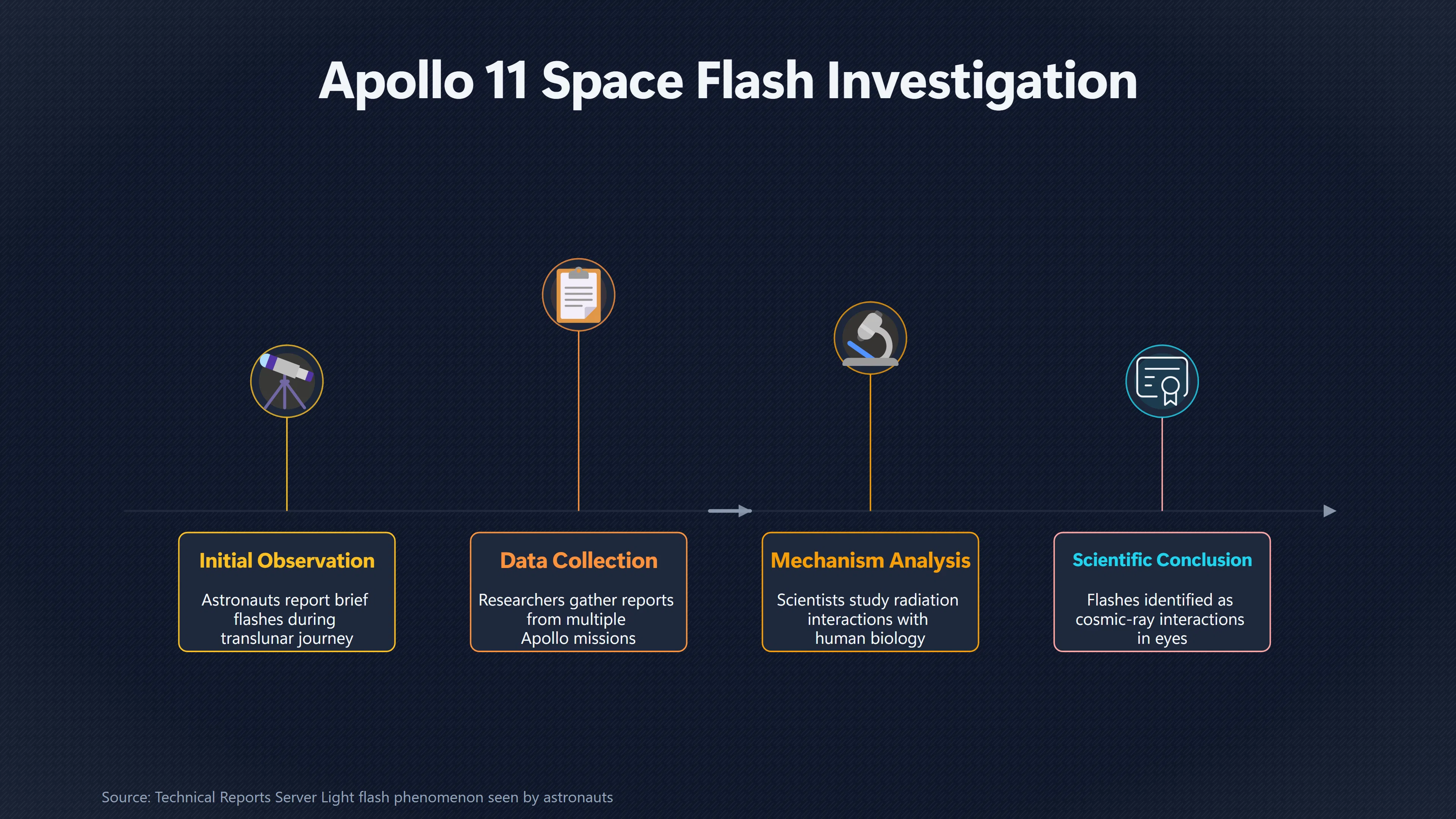
Apollo 11 astronauts first encountered the unusual flashes during the translunar journey, when the spacecraft was travelling between Earth and the Moon. Unlike the better-known Apollo 11 discussions about unidentified external lights, these events were described as visual experiences occurring to the astronauts themselves. The flashes were not seen as objects outside the spacecraft but as brief points, streaks or other shapes appearing in their field of vision.[NASA Technical Reports Server]ntrs.nasa.govTechnical Reports Server Light flash phenomenon seen by astronautsNASA Technical Reports ServerLight flash phenomenon seen by astronauts - NASA Technical Reports Server (NTRS)…
The observations were especially significant because they occurred when the astronauts were outside the region where Earth’s magnetic field provides substantial protection from charged particles. On Earth, the atmosphere and magnetosphere block or deflect much of the high-energy radiation arriving from space. During lunar missions, astronauts were exposed to a different radiation environment, allowing energetic particles to reach them in ways rarely experienced by humans before.[NASA Technical Reports Server]ntrs.nasa.govTechnical Reports Server Light flash phenomenon seen by astronautsNASA Technical Reports ServerLight flash phenomenon seen by astronauts - NASA Technical Reports Server (NTRS)…
The phenomenon was not limited to a single Apollo crew. Reports from Apollo 11 through later Apollo missions showed that multiple astronauts experienced similar flashes during translunar or transearth flight. Researchers used these repeated observations to investigate whether the events were psychological, optical, or caused by interactions between radiation and human biology.[PubMed]pubmed.ncbi.nlm.nih.govPub Med Light Flashes Observed by Astronauts on Apollo 11 through Apollo 17Light Flashes Observed by Astronauts on Apollo 11 through Apollo 17 - PubMedMarch 8, 1974…
Cosmic rays and the human eye explanation
The leading explanation is that energetic cosmic-ray particles interacted with the astronauts’ visual system. Cosmic rays are high-energy atomic particles travelling through space, including heavy atomic nuclei that can pass through spacecraft shielding and human tissue. When these particles crossed the eye or nearby structures, they could trigger a sensation of light without ordinary visible light entering the eye.[NASA Technical Reports Server]ntrs.nasa.govTechnical Reports Server Light flash phenomenon seen by astronautsNASA Technical Reports ServerLight flash phenomenon seen by astronauts - NASA Technical Reports Server (NTRS)…
Early research proposed several possible mechanisms. One suggested that charged particles could generate tiny flashes of light through Cherenkov radiation, a phenomenon in which particles moving through a transparent medium can produce faint light. Another possibility was direct stimulation or ionisation of retinal cells by the passing particles themselves. Scientific discussion continued over which mechanism contributed most, but the central conclusion remained that the flashes were linked to energetic particles rather than external luminous objects.[Nature]nature.comGeneration of Cherenkov Light Flashes by Cosmic Radiation within the Eyes of the Apollo Astronauts | NatureOctober 17, 1970…
Later Apollo-era research strengthened the connection between radiation and the visual events. Experiments and mission analyses found that the rate and characteristics of the flashes matched expectations for interactions between cosmic-ray nuclei and the human visual apparatus. The findings were consistent across multiple Apollo flights, making the explanation more robust than a simple account based on individual perception.[NASA Technical Reports Server]ntrs.nasa.govTechnical Reports Server Light flash phenomenon seen by astronautsNASA Technical Reports ServerLight flash phenomenon seen by astronauts - NASA Technical Reports Server (NTRS)…
Evidence from Apollo experiments and later studies
The strongest evidence for the cosmic-ray explanation came from controlled observations rather than the original sightings alone. Scientists studying the phenomenon collected astronaut reports, compared flash frequencies between missions, and examined how radiation conditions affected the experiences. The Apollo 11 observations therefore became part of a broader biomedical investigation rather than remaining an isolated anecdote.[NASA Technical Reports Server]ntrs.nasa.govTechnical Reports Server Light flash phenomenon seen by astronautsNASA Technical Reports ServerLight flash phenomenon seen by astronauts - NASA Technical Reports Server (NTRS)…
Researchers also looked at the characteristics of the flashes themselves. Astronauts described different forms of visual effects, including spots and streaks, suggesting that the events were not simply ordinary reflections or external lights. The variety was consistent with different particle interactions occurring within the eye and surrounding tissues.[Nature]nature.comLight Flashes produced in the Human Eye by Extremely Relativistic Muons | NatureLight Flashes produced in the Human Eye by Extremely Relativistic Muons | Nature…
The phenomenon was important enough to remain a subject of study after the Apollo programme. Later spaceflight research continued investigating radiation-induced visual sensations because future long-duration missions would expose astronauts to similar deep-space environments. Instruments and experiments on later spacecraft have examined the relationship between particle radiation and perceived flashes, supporting the Apollo-era interpretation.[arXiv]arxiv.orgIn-flight performances of SilEye-2 Experiment and cosmic ray abundances inside space station MirJuly 6, 2001…
Separating visual effects from sightings
The Apollo 11 space flash phenomenon is sometimes grouped together with other “Apollo sightings”, but the evidence points to a fundamentally different category of event. A flash seen inside an astronaut’s visual field is not the same as observing a physical object outside the spacecraft. The distinction matters because it changes the type of evidence involved: researchers are studying human perception under unusual physical conditions rather than tracking an unidentified object in space.[NASA Technical Reports Server]ntrs.nasa.govTechnical Reports Server Light flash phenomenon seen by astronautsNASA Technical Reports ServerLight flash phenomenon seen by astronauts - NASA Technical Reports Server (NTRS)…
The credibility of the reports comes from the astronauts’ careful documentation, not from the idea that their interpretation was necessarily correct at the time. Apollo crews were highly trained observers, but they were also among the first humans to experience this environment. Their reports provided valuable observations that scientists later explained through radiation physics and human biology.[NASA Technical Reports Server]ntrs.nasa.govNASA Technical Reports ServerLight flashes observed by astronauts on Apollo 11 through Apollo 17 - NASA Technical Reports Server (NTRS)…
This makes the Apollo 11 flashes a useful example in evaluating unusual space observations. The event was real, the witnesses were credible, and the initial mystery was scientifically productive — but the eventual explanation came from identifying a mechanism that matched the evidence. The flashes remain notable not as evidence of unknown spacecraft, but as one of the first discoveries of how deep space radiation can directly affect human perception.[Nature]nature.comGeneration of Cherenkov Light Flashes by Cosmic Radiation within the Eyes of the Apollo Astronauts | NatureOctober 17, 1970…
Amazon book picks
Further Reading
Books and field guides related to Why Apollo Astronauts Saw Strange Light Flashes. Use these as the next step if you want deeper reading beyond the article.
An Astronaut's Guide to Life on Earth
Back on the earth after three spaceflights, Chris Hadfield's captivating memoir An Astronaut's Guide to Life on Earth reveals extraordina...
Carrying the Fire: An Astronaut's Journeys
'No other person who has flown in space has captured the experience so vividly' - New York Times Book Review In July 1969, Neil Armstrong...
The Case for Space
"A new space race has begun. But the rivals in this case are not superpowers but competing entrepreneurs. These daring pioneers are creat...
eBay marketplace picks
Marketplace Samples
Live-tested eBay searches with available results related to this page.
Selected fromspace poster oneBay.co.uk.
Endnotes
1.
Source: nature.com
Link:https://www.nature.com/articles/228260a0
Source snippet
Generation of Cherenkov Light Flashes by Cosmic Radiation within the Eyes of the Apollo Astronauts | NatureOctober 17, 1970...
Published: October 17, 1970
2.
Source: ntrs.nasa.gov
Title: Technical Reports Server Light flash phenomenon seen by astronauts
Link:https://ntrs.nasa.gov/archive/nasa/casi.ntrs.nasa.gov/19720016426.pdf
Source snippet
NASA Technical Reports ServerLight flash phenomenon seen by astronauts - NASA Technical Reports Server (NTRS)...
3.
Source: ntrs.nasa.gov
Link:https://ntrs.nasa.gov/citations/19740039499
Source snippet
NASA Technical Reports ServerLight flashes observed by astronauts on Apollo 11 through Apollo 17 - NASA Technical Reports Server (NTRS)...
4.
Source: nature.com
Title: Light Flashes produced in the Human Eye by Extremely Relativistic Muons | Nature
Link:https://www.nature.com/articles/234110a0
Source snippet
Light Flashes produced in the Human Eye by Extremely Relativistic Muons | Nature...
5.
Source: nature.com
Title: Cosmic Ray Flashes in the Eye | Nature
Link:https://www.nature.com/articles/232421a0
Source snippet
Cosmic Ray Flashes in the Eye | Nature...
6.
Source: arxiv.org
Link:https://arxiv.org/abs/astro-ph/0107128
Source snippet
In-flight performances of SilEye-2 Experiment and cosmic ray abundances inside space station MirJuly 6, 2001...
Published: July 6, 2001
7.
Source: nasa.gov
Title: Mission Transcripts: Mercury, Gemini, and Apollo
Link:https://www.nasa.gov/history/mission-transcripts-mercury-gemini-and-apollo/
Source snippet
2, April 1969, 448 pages AS09_LM.PDF | Apollo 9 Onboard Voice Transcription-Lunar Module, March 196...
Published: April 1969
8.
Source: svs.gsfc.nasa.gov
Link:https://svs.gsfc.nasa.gov/13270
9.
Source: nasa.gov
Title: Apollo 11 Audio Highlights
Link:https://www.nasa.gov/history/apollo-11-audio-highlights/
10.
Source: nature.com
Title: Dual origins of light flashes seen in space | Nature
Link:https://www.nature.com/articles/422680a
11.
Source: ntrs.nasa.gov
Link:https://ntrs.nasa.gov/citations/19760005597
12.
Source: ntrs.nasa.gov
Link:https://ntrs.nasa.gov/archive/nasa/casi.ntrs.nasa.gov/19730011140.pdf
13.
Source: nature.com
Title: Predicting Light Flashes due to α-Particle Flux on SST Planes | Nature
Link:https://www.nature.com/articles/241112a0
14.
Source: nature.com
Link:https://www.nature.com/articles/239209a0
15.
Source: nature.com
Title: Visual Sensations Produced by Cosmic Ray Muons | Nature
Link:https://www.nature.com/articles/232574a0
16.
Source: nature.com
Link:https://www.nature.com/articles/230596a0
17.
Source: nasa.gov
Link:https://www.nasa.gov/wp-content/uploads/static/history/alsj/a11/a11trans.html
18.
Source: nasa.gov
Title: Apollo 11
Link:https://www.nasa.gov/wp-content/uploads/static/history/alsj/a11/a11transcript_tec.html
19.
Source: nasa.gov
Title: Apollo 11 Post Flight Press Conference
Link:https://www.nasa.gov/wp-content/uploads/static/history/alsj/a11/a11PostFlightPressConf.html
20.
Source: pubmed.ncbi.nlm.nih.gov
Title: Pub Med Light Flashes Observed by Astronauts on Apollo 11 through Apollo 17
Link:https://pubmed.ncbi.nlm.nih.gov/17756755/
Source snippet
Light Flashes Observed by Astronauts on Apollo 11 through Apollo 17 - PubMedMarch 8, 1974...
Published: March 8, 1974
21.
Source: pubmed.ncbi.nlm.nih.gov
Link:https://pubmed.ncbi.nlm.nih.gov/5479522/
22.
Source: pubmed.ncbi.nlm.nih.gov
Link:https://pubmed.ncbi.nlm.nih.gov/12678106/
Additional References
23.
Source: sciencedirect.com
Link:https://www.sciencedirect.com/science/article/pii/S0939388923000818
Source snippet
February 1, 2024 — ZEITSCHRIFT FÜR MEDIZINISCHE PHYSIK Volume 34, Issue 1, February 2024, Pages 44-63 Review Light flashes a...
Published: February 1, 2024
24.
Source: youtube.com
Title: Astronauts See the Same Light With Their Eyes Closed That You Do
Link:https://www.youtube.com/watch?v=uO2wEna9Zr0
Source snippet
What astronauts see with closed eyes? (only for curious)...
25.
Source: youtube.com
Title: Apollo 16
Link:https://www.youtube.com/watch?v=tLv5h_joAKM
Source snippet
Why Did Apollo Astronauts Wear Boxes Over Their Heads?...
26.
Source: youtube.com
Title: What astronauts see with closed eyes? (only for curious)
Link:https://www.youtube.com/watch?v=MqgeJVLyolk
Source snippet
Apollo 16 - Full Mission Day 3 (ALFMED, Skylab Food, Suit Prep)...
27.
Source: apollojournals.org
Link:https://www.apollojournals.org/alsj/a11/a11trans.html
28.
Source: youtube.com
Title: The Cosmic Ray Visual Phenomenon
Link:https://www.youtube.com/watch?v=gE40fTueUwg
Source snippet
Astronauts See the Same Light With Their Eyes Closed That You Do...
29.
Source: youtube.com
Title: Why Did Apollo Astronauts Wear Boxes Over Their Heads?
Link:https://www.youtube.com/watch?v=y87IMu_wiBw
Source snippet
The Cosmic Ray Visual Phenomenon...
30.
Source: apollo11.spacelog.org
Link:https://apollo11.spacelog.org/
31.
Source: pubs.usgs.gov
Link:https://pubs.usgs.gov/publication/ofr70287
32.
Source: apollo-11.schwagmeier.net
Title: a11trscr cm
Link:https://apollo-11.schwagmeier.net/data/document/a11trscr_cm_html/a11trscr_cm.htm